Showing posts with label history. Show all posts

Monday, August 31, 2015

The Raelyn Shield

Very little is known of King Raelyn before he took the throne. What stories are told are mainly of the Prince getting into just enough trouble to easily get out himself, or sometimes, getting into something larger than himself and escaping only with the aid of his Royal Father. However, one thing is certain: when he was twenty seven, the Prince was disowned.
It seems that shortly after his sister’s ninth birthday, the Prince became involved in a situation that proved more than he could handle. Whatever the circumstances, his father became aware of his position and deemed it the final straw. Apparently, he felt that the Prince’s handling (or mishandling) of his plight was proof that he was not fit to rule. In order to prevent his kingdom from falling into the hands of the irresponsible Prince, His Majesty King Gyrard VII stripped his eldest son of his title and exiled him from the kingdom.
The story goes that Raelyn was given one week to say his goodbyes to the court before he was to be escorted to the nearest border. Before his departure he was given many gifts by his family, especially by his aunt, Avilina, who raised him after the death of his mother. His last visit was to the nine year old Princess Emayn, later renowned as a patron of the arts and an artist in her own right, whose favorite activities at the time were riding her pony and the newly-learned skill of tapestry weaving. (It is said that one of her earliest weavings was a copy of the famous “Battle of Thannsteig,” and that Gyrard VII proudly displayed it on the palace walls. Although the original remains in the National Museum, the Grand Duchess’ copy has been lost to time).
Emayn gifted her brother with a small shield, which, it is rumored, he had used as a child and had given to his sister when he had outgrown it. She also gave him a lecture, which some chroniclers have chosen to romanticize, claiming that the Princess professed her love for the Prince and declared that she would miss him very much. It is more likely, however, that the young Emayn chastised her older brother in an “I told you so” fashion. No matter the contents of her speech, Raelyn fell silent afterward, and sat quietly in the back of his sister’s room, watching her weave.
It was at this point that Gyrard VII’s artist in residence, Lady Sefare, entered the room. Sefare was considered the greatest master weaver of the period, and had been instructing Princess Emayn in the art. It is not known why Sefare attempted to kill the Princess. It is possible that she was hired by an enemy of the royal family, but some have speculated that the desire arose from jealousy at the talent of the young Princess, or perhaps it was simply the result of a tutor’s frustration with a notoriously difficult student.
Upon seeing the knife in the hands of his father’s trusted retainer, Prince Raelyn leaped into action. Using the gift given to him by Emayn, Raelyn blocked the weapon, saving his sister’s life. Lady Sefare was quickly defeated with the knife she had planned to use to murder the Princess. Though many retellings place the vengeful blade in the hands of the Prince, there are versions of the tale that report that Emayn was the one to end things.
However it ended, the Prince’s defense of his sister earned the forgiveness of his father and his reinstatement as the crown prince. It is unknown how much of this story is true, but its effects can be seen throughout history: aside from the way King Raelyn handled trouble during his reign and his lasting attachment to the Grand Duchess Emayn, any student of history can find, in each one of his royal portraits, a small dented shield sitting at his feet.

Thursday, November 6, 2014

Thursday in History: Late

It would be pretty difficult to serve your country’s navy: to be away from home for months at a time, to be in dangerous situations while capturing merchant ships to support your country in a time of war, and to miss out on important things like family birthdays or current events. It would be even worse to return home and find out that the country you had been sweating and bleeding for didn’t exist anymore.
On this day in history in 1865, the CSS Shenandoah returned after a long cruise. They had been very successful in their mission to disrupt various economically important vessels of their enemies, but the mission had lasted longer than anticipated: the ship had actually circumnavigated the globe.
Unfortunately, instead of being praised as heroes and given a parade, the crew of the Shenandoah was forced to surrender. The war had ended seven months earlier and the Confederate States of America was no more.
The only Confederate flag to circumnavigate the globe,
lowered in surrender by the crew of the CSS Shenandoah
on this day in history in 1865.
(via wikipedia)
Fortunately, they had caught wind of the news and so headed to a safer port, even though it was across the Atlantic in Liverpool. They were (rightly) apprehensive about being hung for piracy in the United States, even though they hadn’t attacked any actual US vessels while they were out circumnavigating Earth and taking merchant ships.
Many of the officers and crew eventually trickled back to the New World, starting new careers or heading to college. Others joined the crews of ships heading elsewhere. So even though the CSS Shenandoah was too late to be celebrated, it was one of the Confederacy’s most successful ships.

Monday, November 3, 2014

Fall Back

The alt+text for this comic reads, “As best I can tell, I was transported here from Earth Prime sometime in the late 1990s. Your universe is identical in every way except for the lobster thing, and the thing where some of you occasionally change your clocks for some reason.”
Daylight Savings was a thing we started doing during the Great War. All the boys were off in Europe fighting, and those that weren’t (plus the women) needed more time to get the harvest in. People at the time thought that the act of changing their clocks was ridiculous and a lot of them were like, “yeah, I’m not doing that.” But then the government was like “but, WAR, guys,” and made it a patriotic thing, so people stopped complaining and changed their clocks and still thought it was kind of ridiculous but didn’t want to say anything because they didn’t want anyone else to think that they didn’t support the war effort.
Now, however, the only thing Daylight Savings is good for is for one day of sleeping in during the autumn and several weeks of hate-filled, jet-lagged mornings in the spring.
Maybe we should all try to “fall back” to Earth Prime. I’d be okay with giving up lobster.

Thursday, October 16, 2014

Thursday in History: The Library of Alexandria


It’s always too soon to joke about the destruction of the Library of Alexandria. One of the Wonders of the Ancient World, this place was amazing. It was built by Ptolemy I, the guy who took over ruling the Egyptian piece of Alexander the Great’s empire. The Library was full of innumerable scrolls which scholars from all over the place used to study when they came to research and learn at the Musaeum of Alexandria.
The Library may never have gained much fame had it not been destroyed, and all its works lost. There are differing accounts as to when the destruction happened: one romantic account has Marc Antony and Cleopatra perishing in one another’s arms as the Library burned around them; another says that Emperor Aurelian was putting down a revolt and accidentally damaged the area of the city where the library was located; and one blames the loss of the Library’s contents on Pope Theophilus. However it happened, all of those scrolls, all of that knowledge, that potential to learn, was lost. Wikipedia put it quite nicely: “though it is unknown how many scrolls were housed at any given time, their combined value was incalculable.”
That word: incalculable, is pretty descriptive. Whenever I think about the Library of Alexandria, I daydream about the kinds of things that were there, and what we might know today if it had not all been destroyed. It makes me sad. So yes, even though it’s kind of funny to say, I really do think that it’s always too soon to joke about the destruction of the Library of Alexandria.
The original Library didn't have a website. The new one does: bibalex.org
On this day in history in 2002, the gorgeously amazing piece of architecture which is blessed to be the modern installment of this ancient wonder of the world was officially inaugurated. It sits right on the Mediterranean, and has many interesting features: the largest reading room in the world, the Espresso Book Machine (which prints books for you right when you want them), and various specialized libraries and museum exhibits.
750,000 square feet of reading space on eleven levels. I wonder how far a "Shhh!" carries.
It may not be the wealth of information that its ancient counterpart once was, but maybe someday it will be. In the meantime, it is a breathtaking piece of architecture that symbolizes the hope that the world could build a library like the one in ancient Alexandria.

Thursday, September 25, 2014

Thursday in History: Revolution and Independence

I had a really great professor for African History in college. He was passionate about his subject, and taught the facts with the addition of humor, making his subject both interesting and amusing. Actually, he was the professor who inspired me to become a history major.
His favorite rant was about the decolonization of Africa. Africa had been “colonized” by Europeans differently than other areas. North Africa, of course, had been in the hands of various different European powers for as long as anyone could remember. The rest of Africa had been carved up by some politicians at a peace conference (it’s why lots of African countries have such straight border lines, as opposed to the meandering river borders Europe has). It was divided near the end of the time when having colonies was all the rage, and those politicians realized that there was an entire continent that they’d overlooked that could be owned.
Since it had been colonized rather “late in the game,” many places in Africa were rather tardy to be decolonized, as well. Many had to fight for their independence, even though having colonies in the 1960s was viewed similarly to the way smoking is today: other people/countries would look at you distastefully and say, “You really… shouldn’t have a colony, you know… it’s really bad for you.”
Mozambique began their fight for independence on this day in history in 1964. Today, they celebrate Revolution Day. And judging by my professor’s rants, I’m surprised today isn’t a holiday in the Democratic Republic of the Congo to celebrate the death of their former monarch, King Leopold III of Belgium, who died on this day in history in 1983.
The people of the Congo fought for their independence as well, but Belgium was reluctant. Finally, they agreed that independence was the best idea for everyone involved, and decided to have a party. The leaders of the new free state were invited to give speeches, but only after the Belgian crown had their say, of course. Leopold was represented by his son, as he had been forced to abdicate by the Nazis during World War II. King Baudouin made a beautiful speech, praising the “civilizing mission” that his grandfather, Leopold II, had brought to the country. The new leaders of the new former colony, however, disagreed with the content of the speech, and instead of speaking as he had planned, Patrice Lumumba took the stage and delivered a scathing denouncement of Belgian “civilizing” that shocked (and pleased) attendees and nearly caused an international incident.
Happy Revolution Day, Mozambique. And my condolences, Belgian royal family (though the people of the DRC probably don’t feel the same way).

Thursday, September 18, 2014

Thursday in History: Stealthy Photos from 7.25 Million Miles Away

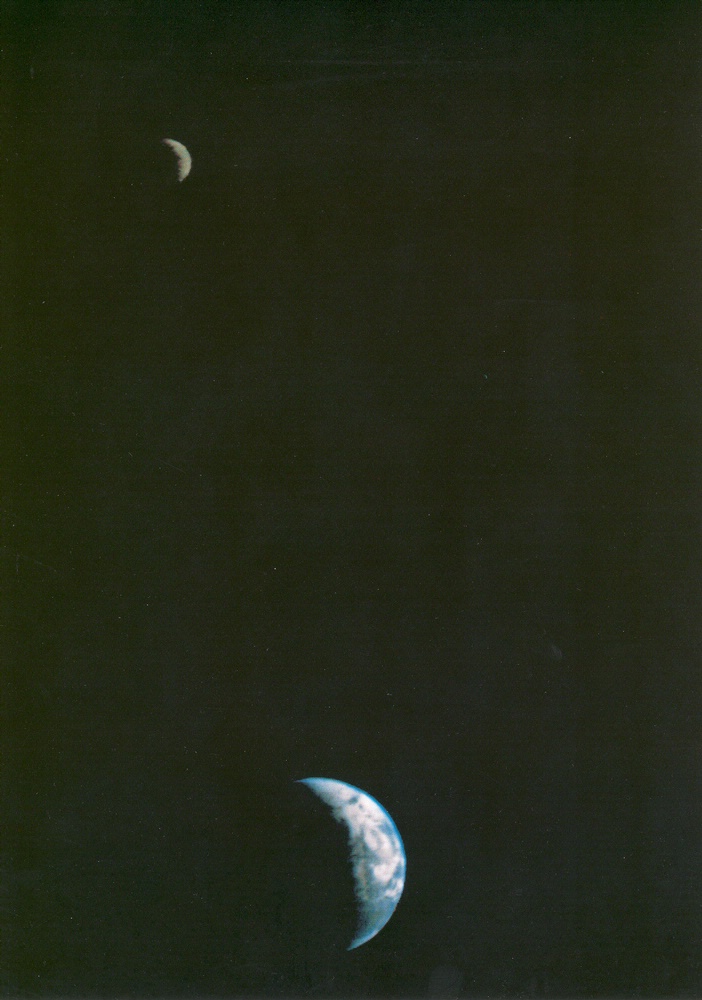
On this day in history in 1977, NASA space probe Voyager 1 snapped the first photograph of the earth and the moon together.
Prior to this photo, there had been pictures taken of the earth from space and pictures taken of the moon from space. People wondered if they were maybe the same planet, since no one ever saw them together, until about 1966 when the moon was taking a selfie and the earth swooped in for the photobomb.
August 1966 "selfie" of the moon (actually taken from lunar orbit)
(via phys.org)
Nobody ever got them to sit still for the same photograph until Voyager 1 was on its way to chill with Jupiter and happened to look back and see the earth and the moon sitting close together enough to photograph.
Voyager 1's September 18, 1977 photo of the earth & moon together
(via Smithsonian National Air & Space Museum)
We can assume that after it was taken, the planetary bodies darted away from each other, covering their faces, like junior highers who weren’t ready for their visages to be recorded on film.

Thursday, September 11, 2014

Thursday in History: Coincidence and Conspiracy

With the recent Sherlock craze sweeping the world, a while back Amazon offered a free kindle version of all of Arthur Conan Doyle’s works on Holmes. I’m sure I was one of many who snapped up the opportunity, but I’m not sure how many actually got through them all. I’m not saying that they’re not well written or interesting, it’s just that there are certain times when ACD kind of just… starts telling a different story. Right in the middle of the one you were interested in. He would usually bring it back around and link it to the story he’d already been telling, but occasionally it was like “um… why should I care about this?”
For instance, in A Study in Scarlet (that’s A Study in Pink for you BBC Cumberbatch/Freeman lovers), Holmes cunningly catches the bad guy, and promises to explain everything, after which the story suddenly becomes a novella about how a group of Mormons rescues a pair of travelers who had no hope for their own survival. And the reader is like, “uh… what does this have to do with anything?!” Eventually it has everything to do with it, but leaves you going, “dude, I think that may have been too much back story.”
In Valley of Fear, Holmes focuses on draining the moat (yes, a moat) around the home of a brutally murdered man, only to have the man himself come forward to confess that the corpse was that of the attempted murderer, and that he had reacted in self defense, which included dressing his attacker in his own clothes to deter any further attempts. When the question of why the murder was attempted in the first place is asked, the reader is then treated to a novel-length interruption about a young man who moves into a new area and joins a guild that he had been a member of in another town. (ACD, who was a Freemason himself, changed the name of the guild to “Freemen,” presumably so he wouldn’t be sued or maybe killed by fellow guild members.) Another character tries to warn him, “dude, those guys are bad news in these here parts,” but he doesn’t listen. In fact, he doesn’t seem to mind. He joins in their bullying of various people in the surrounding area, eventually becoming one of the highest ranking members. When the guildmaster begins to hear rumors about investigation, the young man swears he’ll get to the bottom of it. After gathering all the guild’s heavy hitters in his apartment to spring a trap on the investigator and police, he springs another: he was a mole, and it was his job to make sure that he had enough evidence to send all the men he had gathered to jail. As a result, the other members of the guild (and the men who were eventually released from jail) had been chasing him ever since (which was presumably why he’d ended up buying a house with a moat).
On this day in history in 1826 a Freemason by the name of William Morgan was arrested for “debt.” He had actually trained as a stone worker and had joined the Masons in Rochester, New York.
See, guilds in ancient times were unions. You could refuse to pay one bricklayer his decent wage, but when a screaming mob of them demanded fair compensation, there wasn't much you could do but give it to them.
Another role that guilds filled was an after-work club: just dudes, sitting around when their work was finished, griping about it. Like a gathering of Starbucks baristas complaining about picky customers.
Morgan had moved his family to Batavia, New York and attempted to join the local Freemasons, and went off the handle a little when they denied him. “I’m totally going to write a book about all the Freemason secrets,” he boasted, “and I’ve already got a publisher and everything and we’re gonna make tons of money and high five each other, and then you’ll be sorry you didn’t let me in!”
The Freemasons in Batavia must have had some pretty dark secrets, because things got a little nuts. Somebody put up an anti-Morgan advertisement. There were reports that certain individuals attempted to burn down his publisher’s office. And then, Morgan was arrested. His publisher went to bail him out, and after that… Morgan disappeared. Morgan's widow married again and moved west with her new husband, where they joined the Church of the Latter Day Saints.
There are many theories about Morgan’s disappearance. Was he killed? (The body that washed up on the shore of Lake Ontario a year later was buried under his name, but the distraught widow of another man claimed that the clothes belonged to her husband.) Did he flee the country? (The Cayman Islands were nice in those days, as long as they weren’t hanging you for piracy.) Did the Freemasons drop $500 just so that Morgan would get himself out of the picture?
If they did, they wasted their cash; Morgan's publisher made tons after the book Morgan wrote became a bestseller. It was even one of the factors that sparked the creation of the Anti-Mason Party, who ran a presidential candidate against Andrew Jackson in 1832.
What really happened to William Morgan? Was his story fabricated as a tool for the anti-Masonic movement? Did he live out his life in foreign parts under a false name? Or was he killed by some angry Masons who hoped to silence him? Perhaps the whole thing was merely a conspiracy.
Nearly a century later, Arthur Conan Doyle wrote about similar circumstances. And today, there’s a television show based on his works, starring an actor whose last name is Freeman.
Coincidence? Or… conspiracy?

Thursday, September 4, 2014

Thursday in History: A Historically Significant List

Wikipedia is funny. It’s got tons of information on tons of different things, so it’s usually a good place to go to find some information. Every Thursday I search the day and look at some of the things that happened on that day in history. I pick something interesting, or look for patterns of several related interesting things. On a slow day, I have to scroll down to the holidays, and on an even slower day, I scroll through the births and deaths to look for a well known name, hoping to write about an interesting person’s life (or death).
On this day in history in 2014, I searched “September 4” on wikipedia, and found a wealth of interesting things. A couple of deposings (a Roman Emperor―the end of the Western Roman Empire, Napoleon III―the end of the Second Empire of Napoleon), treaties signed, the beginning of the electrical age, disastrous plane crashes, important wartime occurrences, and the birthdays of several different important things, such as Google, Kodak, and the city of Los Angeles.
Also, in 1995, WCW Monday Nitro made its debut on TNT.
If it’s important to somebody, it’s probably on wikipedia. And just because it’s important to some people, doesn’t mean it’s going to be important to everyone. Every day is historically significant in its own way to different people. To some, today will be remembered as the day that Arkansas’ governor summoned the National Guard to stop nine students from enrolling in high school. And others will be celebrating the television debut of “professional” “wrestling.” Although I may be able to easily see which of those two events is more historically significant, I don’t have any information on how many lives may have been changed for the better by Monday Nitro.
Wikipedia is funny. It’s full of information about things that are important (historically or otherwise) and it’s a great place to start researching pretty much anything. Though when you do, you should remember that while it may have the accurate information you need on the 2010 New Zealand earthquake, it’s also got plenty of other stuff. And it will put all of that stuff on a list with other things that continue to have an impact on the world’s population, even if they happened centuries ago.
So let’s all remember September 4th, the day when empires fell, monarchs rose, and brave soldiers fought and for the future of their countries and the world. Oh, and when Ted Turner brought a new show featuring shouting and big muscles to TNT to rival the one on USA Network. That should go without saying.

Thursday, August 21, 2014

Thursday in History: Irresistible Smile

It would be difficult to live and work in a country that was not your own. It would be even harder to look at a masterpiece of art from your home every day, and wonder why it was not gracing a museum there, where your fellow countrymen could gaze upon its greatness. You might start to think that it wouldn’t be difficult to smuggle the thing out under your coat after hours and take it home, to the city where it was painted. It would probably never enter your thoughts that doing so would cause a field day for counterfeiters, and you certainly wouldn’t expect that your act of patriotism might make that particular painting one of the most famous paintings in the world.
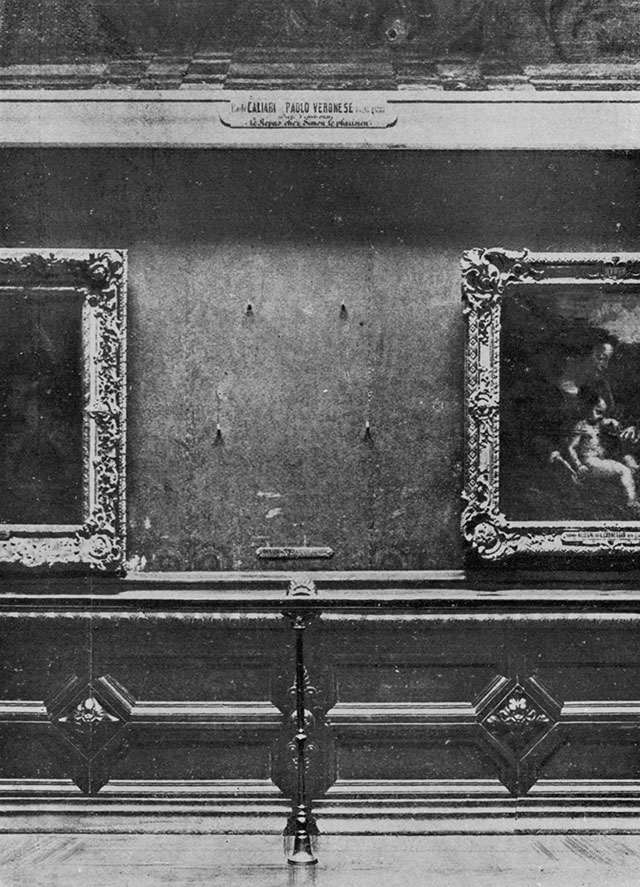
On this day in history in 1911, Vincenzo Peruggia could not overcome his longing for the smile painted by Da Vinci to be in Italy once more, and slipped out the back door of the Louvre with the Mona Lisa.
Painters who had made copies immediately sold out. Poets who had made inflammatory comments about the museum were hauled in for questioning. Even Pablo Picasso was a suspect for a few days. The Louvre was closed for a week while investigators stared, baffled, at the four iron pegs in the empty spot on the wall where the painting should have been.
Missing Mona Lisa (via wikipedia)
But even a patriot who longs to return a stolen treasure to its homeland is bound to get impatient after a while. It took Peruggia two years to get squirrelly and be a bit too indiscreet while negotiating with a Gallery in Florence for the painting.
The Louvre didn't get the Mona Lisa back until after it had taken a tour of Italy in 1913. After that, they kept it under closer watch. Additional precautions were taken after several attempts by vandals to destroy the painting.
Fame isn't everything. And though some may say that the only reason the painting is so adored is because it was stolen, there is always something to be said for an irresistible smile.

Thursday, August 14, 2014

Thursday in History: Terrified of the Future

It’s impossible for an inventor to know how future generations will use an invention: how it will be improved, if it will be overshadowed by something new, or whether it will be completely ignored. All one can do is hope that their invention improves the state of the world and makes life better or more convenient for those who come after.
On this day in history in 1888, one of the first audio recordings in the world was played at a press conference in London on Thomas Edison’s phonograph. Listeners were treated to a piece by one of the foremost English composers of the day: “The Lost Chord” by Arthur Sullivan.
At one of the parties held shortly after the debut, Sullivan himself was treated to a demonstration. He thought the invention and the accomplishment Edison had achieved was wonderful, but had he had some reservations. “I can only say that I am… terrified at the thought that so much hideous and bad music may be put on record forever…”
If Sullivan and Edison could listen to some Top 40 Hits today, I wonder what they would say.

Thursday, August 7, 2014

Thursday in History: Arrival

I always used to enjoy listening to my anthropology professors discuss the different ways that ancient peoples made their way to live in what is now North and South America. Of course we have evidence of Viking settlements arriving from the east, but most of my professors enjoyed talking about incursions from the west.
The two most popular theories were that ancient people traveled across the land bridge which is now the Bering Strait, or that they sailed across the Pacific Ocean, settling any islands they found on the way.
On this day in history in 1987, American long distance swimmer Lynne Cox improved relations between the Soviet Union and the USA by swimming the Bering Strait from Little Diomede (belonging to the US) to Big Diomede (territory of the Soviet Union). Her accomplishment wasn’t meant to be anthropological, but the reason it’s linked in my mind is because of what happened on this day in history in 1947.
Thor Heyerdahl, a Norwegian ethnographer (a way of studying cultures that looks at things from the prospective of those who lived in it) had arranged an expedition to travel from Peru to Polynesia. The Kon-Tiki was built out of materials native to the area that Heyerdahl believed could have been used by pre-Colombian peoples. In 101 days, he and his crew of 5 sailed across the Pacific to prove that the raft could have made the trip. It did, but its landing was far from safe. On this day in history in 1947, the Kon-Tiki was crushed by a reef off the Tuamotus islands in Polynesia.
It makes me wonder if any of my anthro professors are aware of the events of August 7th: Heyerdahl proved that it was probably possible to sail across the Pacific (though perhaps not safely), and Cox proved that it was still possible to get across the Bering Strait (though you have to swim).

Thursday, July 17, 2014

Thursday in History: Changing Hands

Government powers rise and fall. Kings pass on their crowns to their sons (and in some cases, their daughters), and tyrants are toppled to be replaced by leaders who sometimes plague the people even more.
On this day in history in 1429, Charles VII was crowned king following a great victory over England during the Hundred Years’ War. At the end of the Seven Years’ War in 1762, Catherine the Great took the throne of Russia when her husband Peter was assassinated. A revolution in 1968 caused the reins in Iraq to be passed from the Arabic Socialist Union Party to the Ba’arth Party. And the last King of Afghanistan, after ceding much of his power to parliament, was in Italy for eye surgery in 1973 when his cousin stepped up and declared a republican government. He chose to remain in exile rather than fight for his throne, and about a month later, formally abdicated.
But perhaps the most interesting of all the July 17th crownings and usurpations was during China’s Ming Dynasty. On this day in history in 1402, the Yongle Emperor was crowned Emperor of China, but his rise to power was both a usurpation and, as he believed, a hereditary right.
His father, the Hongwu Emperor, did not want his fourth son Zhu Di to inherit the throne. The first son had died during his reign, and what the Emperor really wanted was for his grandson to have the crown. He gave specific instructions that his fourth son be allowed nowhere near the palace when he died, even to mourn him, so that his chosen heir could establish himself before facing his uncle. These orders were carried out, and the only thing that kept Zhu Di away was the fact that his sons had been “visiting” their grandfather when he died and were now used by his nephew. “You wouldn’t want anything bad to happen to my cousins, would you, uncle?”
But Zhu Di was tricky. He waited until his nephew was busy with summer campaigns, fighting to cement his position as Emperor by getting rid of all of the other people that might appear to claim the throne. Zhu Di avoided the fate of many of his brothers (exile, forced to suicide, demoted to the position of a commoner, etc) by pretending first to be deathly ill and then faking an attack of the crazies.
It was perhaps this indisposition (or the convincing portrayal, anyway) that gained Zhu Di his first major victory: his sons came home to see him. After that there was nothing to be done but to make a quick and amazing recovery, claim that his nephew was under the influence of “evil counselors” and to begin a conflict to “save” his poor, naive nephew from their power-hungry ways.
Zhu Di in his imperial regalia
(via wikipedia)
Military victory, a wealth of traitors ready to report on his nephew’s supply lines, and a steady stream of propaganda allowed Zhu Di to take advantage of a fire at the palace: he claimed that three of the burned bodies were his nephew, the queen, and their son. Amid a crowd of yes-men, he agreed to take control of the government, and to celebrate the occasion, visited his father’s grave.
And though Zhu Di’s takeover and first several years of rule were shadowed by a violent “kill all of my political rivals”-style terror, the rest of his reign was prosperous and his legacy impressive. He ordered the building of the Porcelain Tower. He moved the capital to Beijing and constructed the Forbidden Palace. He received visits and envoys from many surrounding countries, establishing peace with many of China’s neighbors. He stimulated the economy and cleansed the land of many foreign influences. He was a devout Buddhist, encouraged his people to follow the teachings of Confucius, and even allowed religious freedoms to Daoists and Muslims.
Government powers rise and fall. Some follow long, established dynasties, and some are taken in bloody revolutions or quiet military coups. Some are prosperous, and some fail utterly. Some begin with glorious victories, and others are won only through trickery. Only time can tell us the success or failure of any rulers or regimes.

Wednesday, July 16, 2014

Writing Prompt: Boldly Go

Writing Prompt #727

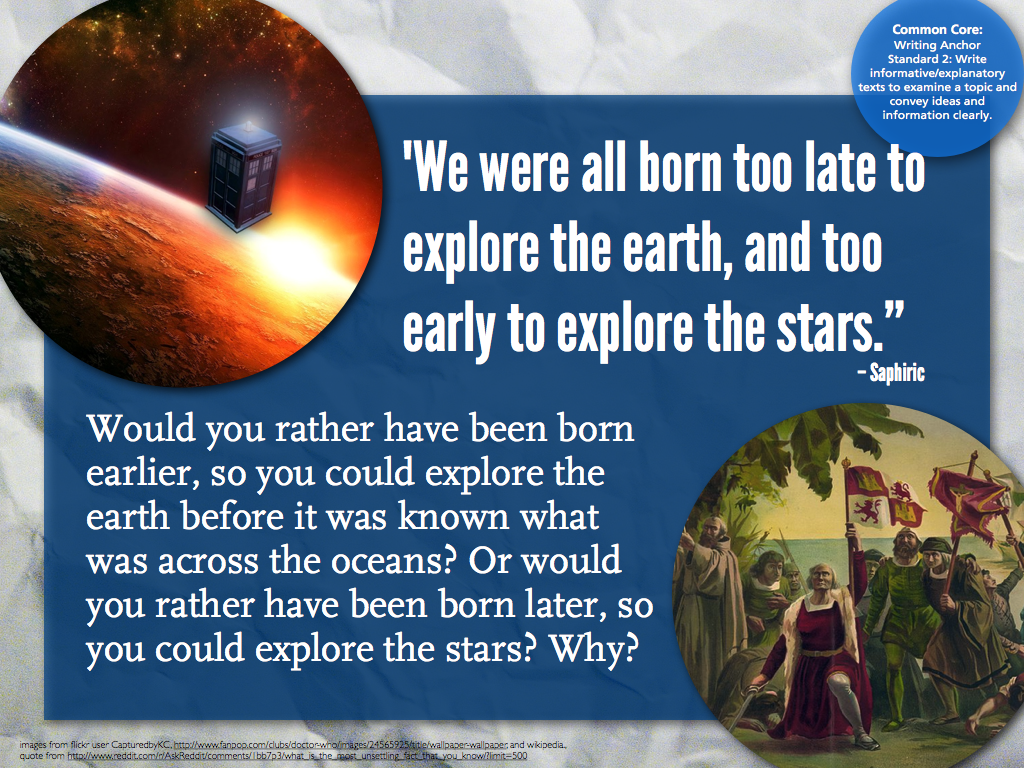
There’s a reason why we love exploration stories. Space, the New World, it doesn’t really matter. People love to watch Doctor Who and Star Trek, and study the parts of history with Christopher Columbus and Marco Polo: brave people, going forth into the unknown without fear, only hoping to find something new and exciting that has never been discovered before.
However, the idea that people today have missed out on their chance to discover something or need to step into a cryogenic freezer to wait until humanity has invented the warp engine is silly. People everywhere on earth are discovering new things in different fields every day.
Engineers are designing products to increase efficiency. Astronomers are keeping their eyes on the skies and finding tons of new planets around other stars. People in the service industry are working hard to make each customer’s day a little better. Teachers are testing out new ways to help people learn. Pharmaceutical companies are experimenting with their products to see which are safe for the public to use. Historians are researching the past, determining the reason behind the actions of people who have impacted it. Writers are dreaming up new ways to make their readers think.
Just because we’re not all on an actual vessel that is headed off for unknown lands doesn’t mean that this is not an age of brilliant discovery.
Whatever it is you do, make it new. Make it better.
Boldly go where no one has gone before.

Thursday, July 3, 2014

Thursday in History: Anticipatory

Today is a significant day in American history.
In 1775, George Washington took command of the Continental Army. The San Francisco Mint was established in 1852. The final day of the Battle of Gettysburg was in 1863. And in 1890, Idaho was admitted as the nation’s 43rd state.
But you may be wondering what everyone was doing on July 3, 1776. Were they eagerly anticipating independence? Did they know that the following day would become one of the most celebrated holidays for our nation? Were they focused on winning a war against those who would oppress our country with taxes and refuse us representation in government?
Maybe.
There were most likely some preparations going on, and obviously the war was already underway. There may have been some delegates jumping up and down in excitement, and others may have been relaxing with a cup of tea before the big meeting.
It’s impossible to project exactly what will happen when representatives of the people gather to decide anything. Will their decision be a lasting one? Will it echo through years? Or will it be repealed, forgotten, or ignored? You don’t walk into a congressional meeting thinking, “this is the day that I and my colleagues make history.”
Or maybe you do.
The Second Continental Congress certainly did.

Monday, May 5, 2014

Fantiquing

Antiquing has gotten very popular lately. I can see the appeal: you get to look at items that were made in the past, sometimes before you were born, and see how they have aged. You can wonder about where they were bought and how they were used and who the people who owned them were. You can look at remarkably lovely and well preserved things, and admire others which were utilized until they were unusable and were placed on a shelf to be handed down to descendants and their shelves. It’s nice that even though their owners may be gone from the world, that the possessions can still be enjoyed by others.
And while antiquing might be fun, I can think of something that might be even more enjoyable and take up much less room. For instance, the collection (that I just made up) of fantiques in my backyard.
What are fantiques, you ask? They are the antiques of the future. The great thing about fantiques is that since they’re from the future and completely imaginary, I can imagine that they’re weather proof. No rain or wind will spoil my fantiques. And I can also imagine that they are stored on a special fantique shelf that will display them for my leisurely perusal and then tuck them away in extradimensional space so that the whole shelf will fit under the back porch.
The lovely fantiques in my collection will range from lavishly decorated tableware that self-washes to gorgeously upholstered chairs and couches that automatically conform to the individual sitter’s sitting needs. There will be future art, both painting, sculpture, and light displays, and everyday things such as a rubbish bin that automatically recycles each piece of garbage into a new item that will make the world a better place.
Perhaps someday all these things will be on shelves being admired in an antique store, and maybe not. But for now I can imagine that they will be, and amuse myself by thinking up so many fantiques that my whole backyard is full.

Wednesday, April 16, 2014

Writing Prompt: The List

Writing Prompt #220
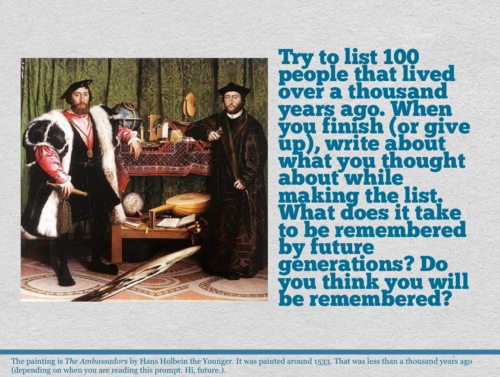
If anyone should be able to actually list one hundred people that lived a thousand years ago, I should. I may stray into mythishness after a while, but I’m confident I’ll be able to at least get the list halfway done. I’m guessing that a good half of the names I can conjure up will be Roman (and if I’m short on names, I’ll have to venture back to Troy). I promise not to cheat and use the internet to look things up. I will only use my college degree. (Ha, I’m using my college degree!)

Richard the Bastard, Duke of Normandy
Ethelred the Unready, King of England
Knut, Viking Ruler of England
Emma, Queen of England (Wife of Ethelred… and Knut)
Godwin, adviser to the King(s) of England
Constantine
Hadrian
Trajan
Valentian
Domitian
Attila the Hun
Nero
Claudius
Caligula
Tiberius
Julia (daughter of Augustus Caesar)
Augustus Caesar (Octavian)
Pontias Pilate
Mark Antony
Cleopatra
Brutus
Cassius
Pompey
Cicero
Julius Caesar
Scipio Africanus
Dido
Hannibal
Sulla
Marius
Gracchus
Cincinnatus
Livy
Plutarch
Paul of Tarsus
Jesus of Nazareth
Joseph of Nazareth
Mary
Elizabeth
Zachariah
John the Baptist
Simon Peter
Andrew
James (son of Zebedee)
John
Matthew
Bartholomew
Thaddeus
Philip
Thomas
Simon the Zealot
James (not the son of Zebedee)
Judas Iscariot
Mohammed
Siddhartha Gautama (the Buddha)
Plato
Socrates
Aristotle
Homer
Virgil
Euclid
Pythagoras
Ptolemy
Alexander the Great
Phillip of Macedon
Xerxes
Nebuchadnezzar
Darius
Daniel
Shadrach
Meshach
Abednego
Esther
Jeremiah
Amos
Obadiah
Malachi
Nehemiah
Isaiah
Solomon
Bathsheba
David
Jonathan
Jesse
Samuel
Saul
Ruth
Boaz
Deborah
Samson
Delilah
Rahab
Joshua
Caleb
Moses
Aaron
Miriam
Ramesses II
Ramesses I
Tutankhamen

Wow, I really thought I’d have to break out the super-ancient stuff that you read about in Greek plays (I really like writing the word “Agamemnon” even if he wasn’t the nicest dude). I didn’t even get to Genesis, let alone The Iliad or The Odyssey, which I guess is good, because a good deal of the characters in Homer’s poems were gods, which is not so much under the heading of “historical figures” and more under the heading of “fictional characters.”
My list (which I tried to arrange from youngest to oldest, but failed near the end) mostly consists of Kings and Queens, and those involved in the drama of Kings and Queens. I’ve got religious leaders, philosophers, and historians; warriors, judges, and prophets. I suppose that’s what it takes to be remembered. I guess if I want to make the list, I’d better get to work.