Monday, September 30, 2013

TableTop: Cards Against Humanity

“The main reason I created #Tabletop was to make more gamers. I love it when I see families playing together.” @wilw, April 6, 2013


I’ve seen a lot of advertisements recently for board games. “Have family time with your kids! Play a board game!” they shout. It’s probably just Hasbro trying not to go broke, but it could be that in this world of handheld computers, with everyone paying attention to their smartphones instead of the smart people sitting with them on the couch, a family game night is a great way to reconnect with the people that you love to spend time with.
There are tons of games out there to play with your kids, your friends, or your extended family. Some are a huge production that take hours and hours to set up before you can play, and others need only the players to have a willingness to be silly. Sometimes just watching the game is as fun as playing it; if that sort of thing appeals to you, you’ll want to look into TableTop.
Dungeons & Dragons takes too much time to prep and doesn’t have enough monster-bashing? Try Munchkin, in which you can “Kill the Monsters, Steal the Treasure, Stab Your Buddy.” I’ve played both D&D and Munchkin, and enjoyed both. D&D often has more story and less stabbing, while Munchkin has less story and more stabbing, but they’re both in the same genre, and if you’re pressed for time, Munchkin is the way to go. (If you’d rather have both the story and the stabbing, there’s luckily a Munchkin pen & paper RPG made by Steve Jackson Games! I walked in on my regular gaming group playing it once and was astonished to find that they’d never played the card version. Needless to say, we remedied that immediately.)
My husband and I loved watching the TableTop episode that featured Say Anything. It reminded us of a game we play every holiday season with his family, especially the copious laughter and the Star Trek references. (The line, “I think the most confusing thing ever is magnets. Also: juggalos” made me laugh so hard that we had to pause the show and wait for me to stop rolling on the floor before we could finish watching the episode.)
If you’ve never heard of Apples to Apples, I would suggest you acquaint yourself. It’s completely simple and tons of fun. Green cards have words that the red cards can be used to describe, and each person takes a turn choosing which of the red cards everyone else handed in matches the green card the best. It’s fun to laugh at the different random, off the wall things that other players say, and my favorite Apples to Apples quote is from a game I played with my brother and several of our friends in 2005(ish): “Marriage is nothing compared to rust.” I can’t even remember who was judging or what the green card said, just that “marriage” lost out to “rust.” Apples to Apples is an innocent game that can become rather rude depending on your mood and the people you’re playing with.
Cards Against Humanity, however, starts out that way. A co-worker described it to me recently as “Apples to Apples for horrible people.” And that’s not far off from the motto on the CaH website. Cards Against Humanity is free, and last night some friends of mine and I decided to give it a try. Teaming up a Skype voice call with Vassal (“a game engine for building and playing online adaptations of board games and card games,”) allowed us to play together, even though we were all in different places, trying to keep the volume of our laughter down so that we wouldn’t wake our kids.
I definitely stole this picture from wwdn.
There isn’t a Cards Against Humanity episode of TableTop, perhaps because it’s a show that a lot of people let their children watch, and it can get out of hand very quickly on the “not suitable for those under X” scales. But Wil Wheaton enjoys it, and if you meet him at a convention and bring along a blank card, he’ll make a custom one for you. He often posts pictures of the CaH combinations he’s seen or created on the various social networks he uses and on his blog.
If you’re a horrible person, I recommend Cards Against Humanity. If you’re not a horrible person and like to watch hilarious (and/or nerdy) people play games, I recommend TableTop. If you don’t like to watch or read about board games, then please disregard all of the above.

Friday, September 27, 2013

Trilogy Bag Count: 20

The last time I reported on Bag the Bag Part 3: the Sequel to the Sequel, it was the beginning of July. The reason is because I decided that the easiest way to keep track of how many bags I’d used was to put them in groups of ten and leave off reporting until I was ready to start a new set. That way I wouldn’t be puzzling over whether I’d used 13 or 17 bags. Of course, now I’m confused as to whether it’s been 20 or 30.
The reason it’s taken me so long to use up ten bags is because of my theory of creative project procrastination, or procraftination, if you will. The more projects you have, the easier it is to put one off in favor of working on the other. So you get lots of things done, just… not what you were hoping to finish. Right now, I’ve got lots of creative projects (colonels and tigers and CONVENTURE, oh my!), so the urge to put them off by working on Bag the Bag Part 3: the Sequel to the Sequel is very high.
I also had a super cool idea for the handles that will hopefully (maybe; probably not) make stitching them on at the end less arduous. I have decided to start the handles early and work them in to the body of the bag. So far I have started three, and have stitched them all in. I’ll still have to attach them to each other, of course, but hopefully it won’t be such a big deal because they’ll mostly be fastened on already. If it works, I’ll do it like this every time. (Oh yes, there’s going to be an every time. I have way too many bags waiting to be used to stop now.)
Oh, you wanted to know about my progress with Bag the Bag Part 2: the Electric Boogaloo? Well… it’s… one. No, not one bag, one stitch. I’d appreciate if we could just ignore that for now. I don’t have any problem ignoring it (even though it’s sitting right next to the computer monitor every day while I write).

Trilogy Bag Count: 20

Thursday, September 26, 2013

Thursday in History: Microfreedom

Everyone, at one time or another in their childhood (or after) has built a fort out of couch cushions or in a tree, or claimed an area of the yard or playroom as a sovereign nation, free from such restrictions as only a single graham cracker for snack or no cake in the evening after brushing one's teeth. Usually, these tyrannical tendencies end when it's lunchtime or afternoon nap. For some, however, the desire to be free survives its playful child-like origins and results in a micronation.
Micronations, according to wikipedia, are "entities that claim to be independent nations or states but which are not recognized by world governments or major international organizations."
Many micronations are jokes, tourist attractions, or moneymaking hoaxes.  The Aerican Empire's capitol is in Montreal, and includes territory all over the world as well as colonies on Mars and Pluto. The Conch Republic in the Florida Keys, with its motto, "we seceded where others failed," began as a protest in 1982 against a US Border Patrol block that was restricting tourism, and though the roadblock is long gone, the micronation continues today as a tourism booster. One of the most famous hoaxes was perpetrated by the famous explorer Gregor MacGregor in 1822, who convinced quite a few people that a native king had given him land for a new kingdom. Micronation hoaxes have continued ever since, offering loans, printing and selling bonds, and laundering money.
On this day in history in 1971,  a group of Danish squatters living in a former military base in Copenhagen declared their territory to be the sovereign nation of Freetown Christiania. This 84 acre area is tolerated but not acknowledged by the government, and has been a place of contention ever since its beginning, and continues to be one today.
If you get the urge to declare your own government, I would recommend the silly/couch style rather than a rioting/financial fraud type. Though I suppose that freedom is freedom, even if it's microfreedom.

Wednesday, September 25, 2013

Crossover Cafe

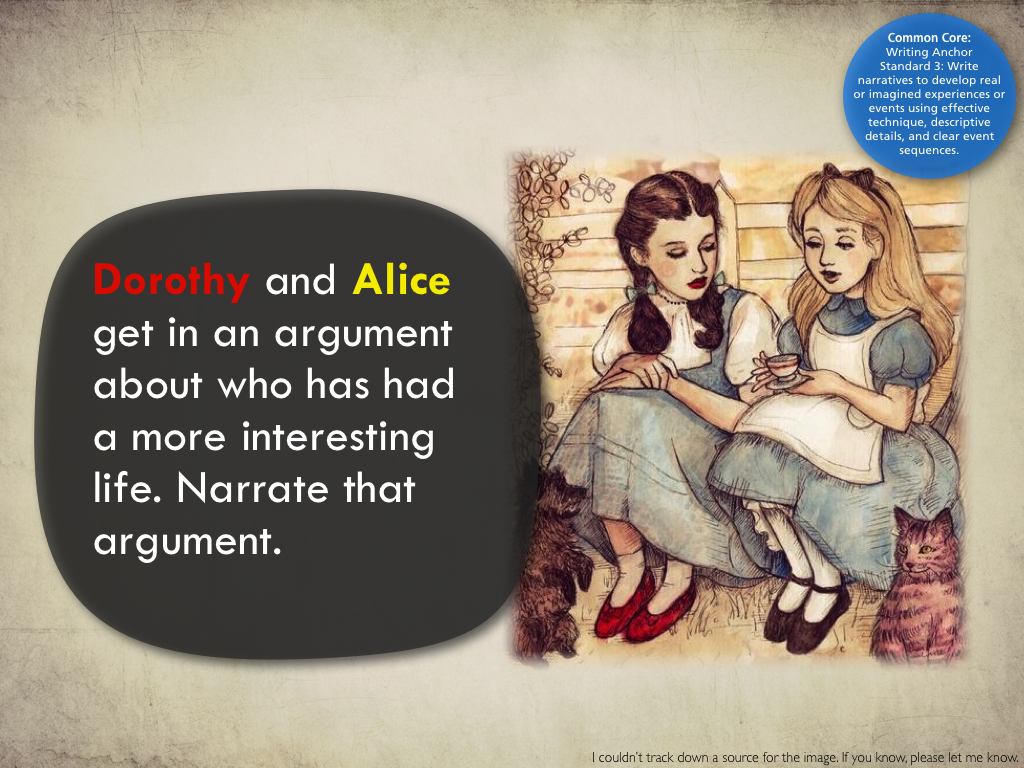
Crossover Cafe is a lovely establishment not far from the fork in the road and just north of the yellow brick road. The Mad Hatter and Auntie Em often met there for tea while Toto chased the Cheshire Cat, and Dorothy and Alice argued.
Last week it had been about fashion: Dorothy advocated for white dresses and blue aprons while Alice stood firmly apposed, in favor of blue dresses with white aprons. The aunt and the hatter had agreed that the whole thing began because Alice was jealous of Dorothy’s ruby slippers, but they thought it would be best not to interfere.
This week it seemed to be about harrowing events in their lives. By the time Dorothy’s aunt and her companion took notice, the girls were shouting at one another.
“Hey! Tumbling down a rabbit hole is harder than it looks!”
“At least I don’t go looking for trouble!”
You’ve never been sentenced to death for no reason!”
“I’d like to see you face down the Wicked Witch of the West!”
“How would you react to being given advice by a caterpillar?”
I saw a giant floating head!”
“Disappearing cats!”
FLYING MONKEYS!”
After sharing a look of concern, the two at tea decided that it was, in fact, time to interfere. But by the time they had exited the cafe, the argument appeared to be over. The girls were laughing together and Dorothy was offering to let Alice try on her shoes.
The hatter shook his head, muttering, “nonsense!” under his breath, and Auntie Em followed him back inside to their table, agreeing, “We ought to be used to it by now.”
Writing Prompt #763
I do not own Alice in Wonderland or The Wizard of Oz.

Tuesday, September 24, 2013

Possibly Helpful, Definitely Annoying

Long ago, before everyone had a computer in their pocket, people used words to convey ideas. Often, these words were written on paper. Occasionally, these words on paper were spelled incorrectly. The only thing to do to make sure that the words you had written on paper were not spelled incorrectly was to ask someone else to make sure. If there were corrections to be made, the words needed to be rewritten on a new piece of paper, or crossed out and the correct word rewritten nearby, or white-out applied and the correct word rewritten on top of the incorrect one.
When I was in high school, this was how assignments were completed. On rare occasions, we were allowed to turn in assignments completed on a computer.
Misspelled words typed on a screen are more easily identified because of the red squiggly thing that underlines them. When you use words to convey an idea on a computer, you don't have to get someone else to make sure none of your words are spelled incorrectly, because the spell checker does that for you.
When an automated spell checker was first introduced, there were no squiggly lines. You had to remember to tell the program to run, just like you had to ask someone to look over your words written on a page. If you forgot, there was no way you would know how many times you'd spelled "definitely" wrong in your English paper. You'd have to wait until Mrs. Lamson handed it back and reminded you that it doesn't have an "a" in it and has only one "l."
I have no experience with the early days of autocorrect software; I stayed away from smart phones for as long as possible for that very reason (among others). Autocorrect doesn't let you forget, but if you skip the bit where you double check that text to your boss, you may be sending him something incomprehensible and weird. From what I understand, autocorrect is supposed to learn your habits and most frequently used words and extrapolate based on those patterns to guess what you mean when you misspell something. Only, I don't misspell things often, and when I do, I mean to. "No, autocorrect," I say, "I didn't mean 'pull lease,' I actually meant it when I typed, 'puh-lease!'" But it's not like autocorrect is listening to me even when I do try to instruct it during these moments of intentional misspelling. I can't say, "Just trust me, autocorrect," and have it leave me alone about how I like to hilariously misspell certain words. I suppose some people definitely have a use for it, but I just find it mildly annoying.
Some days I think I'd like to turn it off, but then I won't be able to tell future generations how much it bothered everyone when they're complaining about their thought-to-text software. "You think that drives you nuts?" I'll be able to say, smacking a dictionary down on the table in front of them. "Let me give you a few links to some 'autocorrect fail' websites!"

Monday, September 23, 2013

Going Analog

When I was in junior high, I had a huge green trapper keeper adorned with hearts around the name of the boy I liked in eighth grade. The three ring binder held loose leaf notebook paper that was full of my silly tales of my made up heroine and her friends. I had an assortment of writing utensils tucked into the various pockets, in addition to a list of potential names for new characters (as though I needed more), charts on who had a crush on who, and I think, at one point, a sketch out of the plot (I eventually lost both).
When my aunt gave me her old word processor, the first thing I did was start to type up my story (playing with its three font options was necessary). I enjoyed it even more when I was able to transfer the file to the old computer my dad let me have (after we’d shoved it onto my tiny desk). Since then, my writing on paper has been limited to times that I couldn’t get my hands on technology to do it: in class (until the LAPTOPS FOR EVERYONE craze hit) or between customers at work (where I wrote the entirety of my 1066 comic).
Sadly, this was not the best decision. Paper can be lost or thrown away or burned in a house fire, but a laptop can crash and its data can be corrupted or it can get stolen or dropped or burned in a house fire. I lost several works, many of which I have not been able to recover.
Since the “Cloud” became a thing, I’ve been storing all of my work online. Keeping it this way has saved it from more than one computer crash. Plus, it’s much easier to collaborate with writing partners who live in different time zones.
But since there was an outage this weekend on a certain website which shall remain nameless, I’ve decided that having a physical copy of my writing is probably a good idea. You never know if the servers that store my work “on the cloud” could be burned in a house fire.
Not that I’m going to self publish my work. I just want a copy that I can hold in my hands and read it, even if it’s in my own handwriting.
And even though copying it all down is going to take a while.

Friday, September 20, 2013

Internet Inspiriation

Crafters, since the ancient days, have formed groups and cabals and societies. We have shared recipes, patterns, and materials, and have encouraged one another while providing ideas for new things to craft.
Before the internet, there were meetings and craft circles, books and magazines.
Now, we have everything we could want at our fingertips. Craft websites have tons of free ideas, forums to share tips and ask for feedback, and even times for offline meetings to discuss projects with other crafters in real life (as it was in the beginning).
(c) Ravelry LLC
Ravelry is an amazing online group of knitters and crocheters. On Ravelry you can buy and sell patterns, make friends and join groups, and recieve the kind of fuzzy warm feelings that only hanging out with other people who love their craft as much as you do can give.
(c) 2013 Etsy, Inc
Etsy is a lovely website for selling vintage goods, handmade goods, and craft supplies. You can sell your creations or buy those of others. Or, if you’ve got ten hours or so and a credit card with a high limit, you can buy every single thing. The work of the sellers on Etsy is remarkable: it’s intricate, exquisite, and breathtaking. You can buy art for your walls, custom shoes for your feet, or an engagement ring for your betrothed.
(c) 2013 Pinterest
Pinterest is a website for everything. I have not signed up or spent much time on it myself, but I have heard many harrowing tales of its capability to suck out your soul, and when you emerge from it, you may find that a week has passed and you don’t remember anything but sleep, eat, and Pinterest.
I have come to the realization that I probably need to join. Sometimes Pinterest will let you look at cool craft ideas, and sometimes it bars you and holds out its hand for your username and password. I want to be able to be inspired by ideas that brides have for photo booth props, but at the same time I’d rather keep my soul intact.
My mother said, “Honey, I’m sure it’s not that bad. You can keep yourself from becoming overwhelmed by a website.” But she hasn’t heard the urban legends that I have. I’m scared.
The internet is a wonderful new tool used by crafters everywhere. Scrapbooking websites and blogs, the facebook pages of famous chefs, and crafting communities all over the internet are inspiring, aiding, and sharing wonderful ideas for crafters today, just as crafters have always done.
I’m off to join Pinterest. If I never return, at least you will know what happened to me. You’ll be able to warn others to beware.