Showing posts with label Dresden Files. Show all posts

Wednesday, November 19, 2014

kindle Love

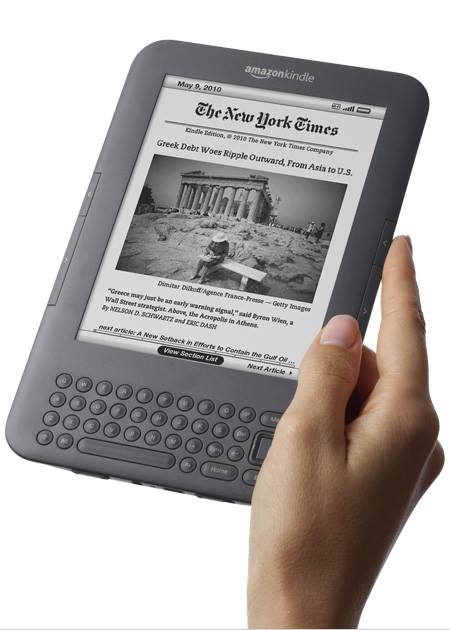
On this day in 2007, Amazon released the first Kindle e-reader, allowing users to download, browse, and ‪‎readebooks, newspapers, magazines, and other digital media.How has the e-reader affected the way that you read ‪‎books?
10600605_10152691408816336_7968604096780845313_n.jpg
From the Writer's Relief facebook page
I saw this post in my facebook feed this morning and stared at the picture for a while. The first kindle I ever held looked exactly like this one, only instead of gray it was white. It had belonged to my husband’s best friend, and he had cracked one corner of the screen (a small crack). So he offered it to us after he ordered a new one. It was still attached to his amazon account, though, and he had all the Dresden Files novels. Since I had already borrowed another friend’s collection of paperbacks to read them the first time, I read them again, and didn’t mind the screen’s cracked corner one bit. I enjoyed highlighting things, getting the definition of a word immediately, and adding notes (the full keyboard was very helpful for this). I’m sure JR enjoys his Tricia-annotated kindle versions of those books now.
Eventually, my husband and I went ahead and purchased our own kindles, to buy ebooks on our own amazon account. We got the cheapest versions, sans-keyboard, and I immediately re-read everything we owned by Jim Butcher so that our versions would have all my highlights and notes. It’s definitely harder to get my thoughts down when I only have an arrow key and “enter,” but the keyboardless version is more compact, and therefore less apt to get its screen cracked if you forgot it was in your back pocket. They’re still pretty delicate, and back-pocket storage is definitely not recommended. I can proudly say that I’m still using my first kindle, while my husband is on his third (admittedly, I was the one who cracked the screen of his first one. The second was all him).
These days, I use my kindle every single day. I reread old favorites and new favorites. I find free versions of classic books and enjoy those for the first time. My favorite thing to do is read a stack of books all at once, a chapter at a time. This is something I definitely can’t do with a hardback; there’s a copy of the Ultimate Hitchhiker’s Guide to the Galaxy next to my bed, but I’d never think of thumbing through it to find the next bit, reading only one chapter, and then putting it down so that I could read a chapter of something else. A tome that heavy has to stay in your lap.
I don’t think I would trade my kindle out for a newer version, unless it was going to be the paperwhite, or something that came with a light attached to the top so I could read it in the dark and not bother my light sensitive husband if I wanted to enjoy books late into the night. I don’t think I’ll ever need a device with a touch screen; buttons suit me just fine. And while it might be nice to have something small to watch movies on while I crochet from the comfort of my own bed, I really enjoy the way I use my kindle now: for books, and only for books.

Tuesday, March 18, 2014

Helpful Advice

When you wake up in the morning and reach for your kindle to resume the reading that you fell asleep to, make sure you read the entire first sentence before you assume you’re in the middle of Pride and Prejudice. Just because the first word on the page is “Lydia” doesn’t mean that you’ve traveled back in time to Regency England. I mean, as long as the next sentence doesn’t refer to the fact that the main character has been arrested recently, you’re probably okay. If it does, you probably fell asleep reading that Dresden Files novel that you’ve already read six(ty) times.
Just a little helpful advice.
I found this gif on knowyourmeme.com.

Wednesday, June 13, 2012

OMGZEITGEIST


Zeitgeist
is "the spirit of the times" or "the spirit of the age." Zeitgeist is the general cultural, intellectual, ethical, spiritual, or political climate within a nation or even specific groups, along with the general ambiance, morals, sociocultural direction, and mood associated with an era.
The term is a loanword from German Zeit – "time" and Geist – "spirit" (cognate with English "ghost").
-"Zeitgeist" article on Wikipedia
I have never liked fads. I never had any pogs, never wore bell bottoms in middle school, and I don’t like Twilight. Lots of people have liked or do like these things, but they don’t interest me. One reason is that I could never see the point of scattering little pieces of cardboard around, I think bell bottoms are ugly, and I’m not into vampires. The other reason is that I generally tend to dislike anything that is currently considered “cool.”


What I have is sort of the opposite of a hipster’s “I liked it before it was cool.” I’m more of the “I liked it way way after it was cool” type. I couldn’t see the point of green nail polish when the popular girls were wearing it in middle school, but in college it was hard to find me without my fingernails painted a strange shade. I was disinterested in the early hullabaloo surrounding the Harry Potter series, and didn’t see any of the movies until at least five of them were out, and now I have seen all of them and have read the books through several times. I absolutely refused to join any social networking sites when they first became really popular, and now my computer is rarely on without being accompanied by facebook.

The only thing I have been on the bandwagon at the time for was the Lord of the Rings movies, and I think that mostly had to do with the fact that I was hanging out every day with a group of friends that were all into them too. Fangirling alone in your apartment is not as much fun as fangirling with a bunch of people. They call solo fangirling “stalking.”

Don’t get me wrong, I will enjoy something whether or not others enjoy it. Although I will usually try to share it with someone else if they will listen, and the one who falls victim to this most often is my poor husband: “So she didn’t want to tell him about it and asked her friends not to tell him, but then this other guy who knew about it tried to tell him so they all tried to make him be quiet and...” He is very sweet and just sits there and lets me talk, and eventually I realize I’ve been talking for ten minutes and he’s been mentally checked out for at least 7 of those minutes, and I finish up with “...but whatever, you don’t care anyway, go back to what you were doing,” and laugh at myself. (And he goes back to playing video games, breathing a sigh of relief that he’s not going to be quizzed on it later.)

I like to watch very popular television programs after they have reached the peak of their popularity and are on the down slope. I never watched Scrubs (until about a week ago), Bones (until the middle of season 5), or NCIS (until about season 6 or so) when other people were watching them. I love all these shows, but one thing I can’t stand is a cliffhanger. I will wait for six months to a year before catching up with them, and then watch everything that’s available except the last two or three episodes. I’m okay to be left hanging between regular episodes, but every single show on television likes to do a little “OH NO WHAT WILL HAPPEN NEXT” episode near the end of the season that makes every viewer hate summer.

And I like summer.

So I don’t watch TV like other people do. The exception to this rule is pretty much everything on USA Network (Burn Notice, White Collar, Royal Pains, etc.). The nice thing about USA Network is that instead of doing one season of shows beginning in the fall and ending in the spring, they break up the season into two chunks. Like, the first half of the season will show in the spring and the second half in the fall, or the first half in the summer and the second half in the winter. Then they stagger when the shows are on, so that there’s always something new showing, no matter what time of year it is. Of course, with a double dose of cliffhanger opportunities per season, there’s more “OH NO WHAT WILL HAPPEN” frustration, but since after one half season ends, another great show starts up again, I can’t be too sad about the disappointing ending of Covert Affairs because, ooh, Burn Notice!

I really enjoy reading a book series after the author is finished writing it. For some people, the anticipation makes the book even better, but for me it’s annoying; I just want to find out what happens! With things that I love, I don’t mind much, because every time a new book comes out is an excuse for me to read the whole series from the beginning again. But my friends have a hard time convincing me to pick up a new series sometimes.

Thankfully, I did not miss out on the works of Jim Butcher due to the persistence of our good friend JR. I was disinclined to start the Dresden Files series: he had made the mistake of telling me that not only was the author remotely close to finishing them but that they also predominantly featured vampires. I never really got excited about vampiry things before the universe got all “OMGZEITGEIST” about them, so now that they are a fad I’m even more disinterested.

JR baited me with Butcher’s finished series, The Codex Alera. The two things that drew me: no vampires, and JR’s description: “Somebody challenged him to write a story combining Ancient Rome and... Pokémon.” That description may turn some people off, so don’t worry, Butcher’s “furies” aren’t really anything like Pokémon. It is plenty Ancient Rome-y, though, and the history major in me was like, “YES PLEASE.”

After I shook JR down for his copies of every book in the series and read them twice, I figured that the Dresden Files would be okay to try, too, vampires and all. I shouldn’t have worried: Butcher’s vampires do not sparkle.

I don’t like popular things. I almost have to be forced to try something that everyone else in the world won’t shut up about. Usually I shrug and say no thank you, but on the rare occasion, I will regret not trying something sooner.

I’m too slow to catch up on what’s popular that I will never be a fashionista, but give me time and I will most likely come around and watch that movie or read that comic that you recommended. 

Unless it’s about vampires.

Monday, April 9, 2012

Happiness is a Good Book

One of the greatest loves of my life is a good story. It doesn’t matter if it’s true or made up, doesn’t matter if it’s told to me by someone or I dream it up myself, and it doesn’t matter if I watch it, read it, or have to fight the same ten French crusaders a million times until I get to find out what happens to Altaïr. I enjoy a good story in any form.

It’s why I have a history degree. My favorite professors were the ones who gave a lecture like they were telling a friend about the latest episode of their favorite TV show. I’d sit there on the edge of my seat and soak it up. I noticed, too, that the lecture would return to the professor in the answers to the essay questions of the tests I took, sometimes down to the exact words. My classmates didn’t really understand why I enjoyed it so much. (Incidentally, if you ever want to be slightly amused for a couple of minutes and then spend the next 15 to 20 trying to get me to shut up, ask me to tell you about the last successful invasion of England.)

When my husband and I got married, I had a great big bookshelf, at least six feet high, and my husband brought two of his own, rather shorter, but deep enough to hold two rows of books on each shelf. They were immediately stuffed with textbooks, historical fiction, D&D sourcebooks, and the works of both Stephen Hawking and C. S. Lewis, in addition to one whole shelf dedicated to DVDs and video games, three cases deep and two high. In the months before we moved away, I spent hours and hours putting a good third or so of the books up for sale on the internet, and getting rid of them in twos and threes.

We still have a good portion of those books, in addition to a couple of boxes stored for “when we move into a bigger place,” and four or five boxes full, which I need to get rid of somehow. We would have even more than we do now, but the best purchase my husband made for us last year was to get us his & hers amazon kindles. (I say “his & hers,” but really they are exactly the same machine and if I didn’t always keep mine in a specific place we’d easily mix them up. The truth is, he wanted one for himself and knew that if he didn’t get one for me that the one he’d purchased for himself would quickly become mine.)

The best thing about having a kindle is the ability to underline something that just resonates with me. I’ve been using it to read so much recently that when I read a particularly amazing passage in a honest-to-goodness paper and print book, I unconsciously reached for the button I’d need to push to manipulate the cursor that would let me underline it. Then I blinked and shook my head like I was waking up, and laughed at myself.

I would never think of underlining or highlighting something in an actual book, but I don’t mind it so much with the kindle. It even keeps track of the things I underline, so that I can go back and savor the best of Jim Butcher’s Dead Beat and roll on the floor laughing without having to read the whole book (not that I would mind doing that, but since it’s in the middle of the series I’d have to start at the beginning again... not that I would mind that either.)

The idea of sullying the page of a book with the touch of a pen, a marker, or even a pencil seems blasphemous to me. I think it was something instilled in me in elementary school, when our textbooks were the property of the school, had been used by the kids one year older than we were, and would be used by the kids in the grade below us next year. It’s like the admonition of the teachers is burned into my brain: “Don’t write in your book!”

It’s also hard to ignore a highlighted passage. You’re reading along, in the middle of a scene, you turn the page, and immediately your eye goes not to the next word or sentence but to the place on the page which the ink is desecrating. (I have the same problem with books that have footnotes.) Then you have to disengage from whatever it says and go back to the place you were originally, maybe even a paragraph or two back, and reinsert yourself into the correct place in the story.

It also makes them pretty hard to get rid of when you’re done with them. (If anyone wants a copy of The Invention of the Restaurant by Rebecca L. Spang covered with my half asleep scrawlings and ideas for the presentation and paper I had to write on it, let me know.) Books lose a lot of their resale value if they’re covered in scribbles. If the scribbles happen to be those of the author, however, the value goes up again. (My copy of The Most Famous Man in America is up for grabs too, sorry Debby Applegate, I did enjoy meeting you!)

I love to read, so it’s sometimes difficult for me to watch movies or television based on the books I love. I recently watched the first episode (and the first episode only) of the Syfy series The Dresden Files. Afterward, I said to my husband, “hey, there were three characters in that show with the exact same names as this book series I love!” I could acknowledge that the show was entertaining, but I was so distracted by the differences between what I’d read and what I’d watched that I was not able to enjoy it the way I was meant to. I’m sure it’s a perfectly good series, but I’m not going to be able to watch it since I am so attached to the books it is loosely based on. I probably would have liked it more if I had watched it before I read the books, but I still would have come to the conclusion that the books are so much better.

That sort of thing is easier when it goes the other way: “expanded universe” books are more enjoyable to me than when a movie changes the way my imagination sees things in a book. When I listened to the audiobook The Stone Rose, it was like getting to watch an extra episode of the 2006 season of Doctor Who in my head (especially since it was read by David Tennant)!

I have purposely avoided watching things like Showtime’s The Tudors, since I’ve studied that particular place and time in history a bit more than others. I’m sure I would enjoy it to some degree, but anyone watching it with me may not like it whenever I had to shout “NO, WRONG” at the screen and having to pause it to listen to me talk about why it was wrong and what really happened and then inevitably coming around to the understanding of why they decided to change it that particular way but that it was still probably going to mess things up later.

The one movie that I still enjoyed, even though it was different from the original book in quite a few places was The Hitchhiker’s Guide to the Galaxy. Part of the reason I was okay with it being different (especially the ending!) was because I had recently purchased “The Ultimate Hitchhiker’s Guide,” and in the introduction, Adams admits that “The history of The Hitchhiker’s Guide to the Galaxy is now so complicated that every time I tell it I contradict myself, and whenever I do get it right I’m misquoted. So the publication of this omnibus edition seemed like a good opportunity to set the record straight--or at least firmly crooked. Anything that is put down wrong here is, as far as I’m concerned, wrong for good.”
I also didn’t mind the changes because I knew the kind of involvement Douglas Adams had in writing the screenplay for the movie. I feel that if the author thinks the changes are okay, they should be okay with me, too.

Sometimes, when I’m reading a book, I start to think about how it would be on the big screen. Or I’ll read a certain scene and think, “I can’t wait to see the movie they make out of this book, just for this part!” That was how I felt a lot of the time watching Peter Jackson’s Lord of the Rings trilogy. For me, it’s hard to find fault with those movies, even though a few things were different from the book, since almost everything in them looks exactly the way I had imagined them (even “Mr. Bilbo’s trolls”).

The best thing that my love of stories has given me is an understanding of things I would never experience on my own. Because I have this passion, I am able to relate the interesting story of why America has building codes. I know what it’s like to live in modern-day London. And I can explain how one could go about learning to fly (the main idea is to throw yourself at the ground, but miss). The more you love to read, the more new things you will learn. Because when you’re enjoying the story, you don’t even notice that you’re gaining new knowledge; it sneaks in while you’re having a good time.

I hope to instill this love of stories in my children. My husband enjoys stories as well (not quite as much as I do), and we like to sit around talking about the implications of the two European fronts in World War II, or the quiet hints of things to come sprinkled all through a season of Doctor Who. So, I’m sure to succeed in inspiring the same passion for stories that I have in my children.

We certainly have enough books for them to choose from.