Showing posts with label Hitchhiker's Guide to the Galaxy. Show all posts

Wednesday, November 19, 2014

kindle Love

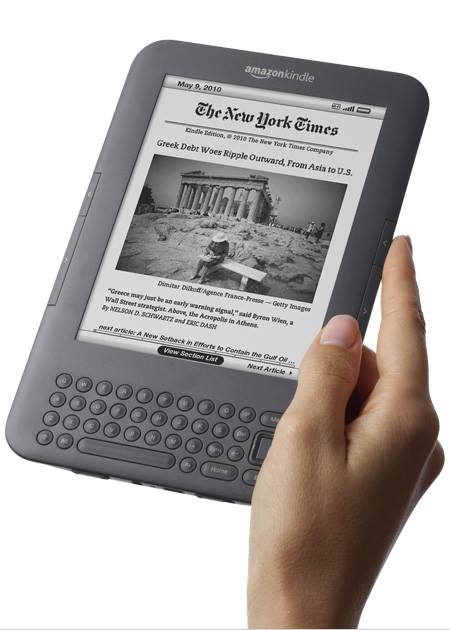
On this day in 2007, Amazon released the first Kindle e-reader, allowing users to download, browse, and ‪‎read ‎ebooks, newspapers, magazines, and other digital media.How has the e-reader affected the way that you read ‪‎books?
10600605_10152691408816336_7968604096780845313_n.jpg
From the Writer's Relief facebook page
I saw this post in my facebook feed this morning and stared at the picture for a while. The first kindle I ever held looked exactly like this one, only instead of gray it was white. It had belonged to my husband’s best friend, and he had cracked one corner of the screen (a small crack). So he offered it to us after he ordered a new one. It was still attached to his amazon account, though, and he had all the Dresden Files novels. Since I had already borrowed another friend’s collection of paperbacks to read them the first time, I read them again, and didn’t mind the screen’s cracked corner one bit. I enjoyed highlighting things, getting the definition of a word immediately, and adding notes (the full keyboard was very helpful for this). I’m sure JR enjoys his Tricia-annotated kindle versions of those books now.
Eventually, my husband and I went ahead and purchased our own kindles, to buy ebooks on our own amazon account. We got the cheapest versions, sans-keyboard, and I immediately re-read everything we owned by Jim Butcher so that our versions would have all my highlights and notes. It’s definitely harder to get my thoughts down when I only have an arrow key and “enter,” but the keyboardless version is more compact, and therefore less apt to get its screen cracked if you forgot it was in your back pocket. They’re still pretty delicate, and back-pocket storage is definitely not recommended. I can proudly say that I’m still using my first kindle, while my husband is on his third (admittedly, I was the one who cracked the screen of his first one. The second was all him).
These days, I use my kindle every single day. I reread old favorites and new favorites. I find free versions of classic books and enjoy those for the first time. My favorite thing to do is read a stack of books all at once, a chapter at a time. This is something I definitely can’t do with a hardback; there’s a copy of the Ultimate Hitchhiker’s Guide to the Galaxy next to my bed, but I’d never think of thumbing through it to find the next bit, reading only one chapter, and then putting it down so that I could read a chapter of something else. A tome that heavy has to stay in your lap.
I don’t think I would trade my kindle out for a newer version, unless it was going to be the paperwhite, or something that came with a light attached to the top so I could read it in the dark and not bother my light sensitive husband if I wanted to enjoy books late into the night. I don’t think I’ll ever need a device with a touch screen; buttons suit me just fine. And while it might be nice to have something small to watch movies on while I crochet from the comfort of my own bed, I really enjoy the way I use my kindle now: for books, and only for books.

Wednesday, April 9, 2014

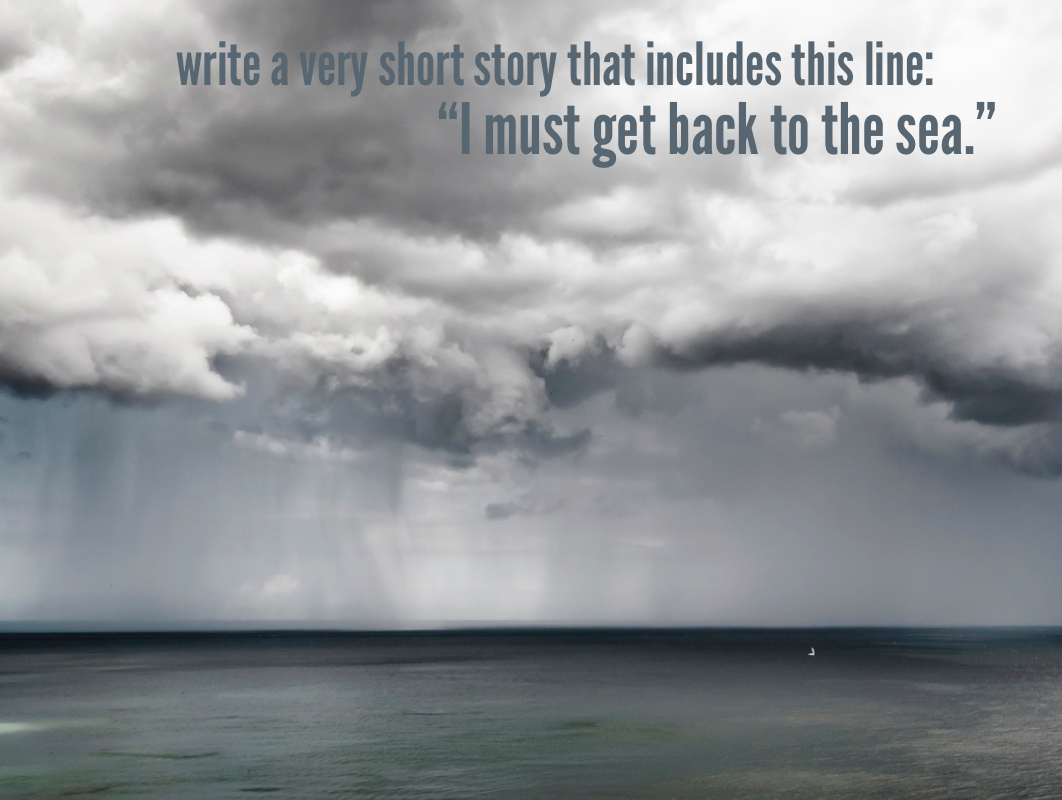
Writing Prompt: Back to the Sea


“Many were increasingly of the opinion that they’d all made a big mistake in coming down from the trees in the first place. And some said that even the trees had been a bad move, and that no one should ever have left the oceans.”
--Hitchhiker’s Guide to the Galaxy

As time advances, so does our ability to look back on it. We watch things change, and we remember how they used to be. Some people are hopeful, looking to the future for wonderful things. And some are sad, and know in their bones that things were better in the past and that they can never get back to it.
Usually, hopeful people like Wade Miller and sad people like Ruben Hopkins can get along together well. Except for when Ruben has a bad day.
Wade reminds him that tomorrow will be better! Tomorrow, the sun will rise again, and all of today’s woes will be gone.
Ruben never listens. He stares out the window of their beachfront apartment and refuses to be comforted. “Evolution was a mistake,” he moans, wishing he could live the uncomplicated life of an ocean creature. Wade smiles, shaking his head. “On days like this,” Ruben continues, “I really wish there was some way for me to get back to the sea.”

Thursday, April 11, 2013

Thursday in History: Not Much Happened


The Hitchhiker’s Guide to the Galaxy is a book that seems largely to be comprised of many amusing situations that don’t really lead much of anywhere. Arthur Dent tries to get the spaceship Heart of Gold’s drink replicator to make a decent cup of tea and ends up shutting down everything on board but the most vital life support functions. While trying to escape from some missiles headed for them, the crew of the Heart of Gold turns on the ship’s Improbability Engines and turns the deadly missiles into a blue whale and a bowl of petunias instead. In their exploration of an alien planet, the adventurers discover that not only was the earth designed by planet-building aliens, but the alien who engineered the architecture of the Norwegian fjords won an award for them.
It seems like a lot of nonsense, but the characters in Douglas Adams’ book actually do have a goal. It’s really the same goal that all of us have: to find the meaning of life (the universe, and everything).
If you’re up for some spoilers, I’ll tell you what happens. They eventually find a historical archive that tells them the story of how in the ancient past a computer called Deep Thought was built with one purpose. And after centuries of calculating, it achieved what it was built for; it spit out The Answer to Life, the Universe, and Everything: 42. The excited listeners’ hopes were dashed; what kind of an Answer was “42?!” In response to their outrage, the computer explained that it had been tasked with calculating The Answer, and its programmers had said nothing about The Question. You’ll have to read the books to discover what the characters found out about the The Ultimate Question of Life, the Universe, and Everything.
In 2007, a man in Cambridge, England launched a technology company dedicated to producing an answer engine of its own. And in 2010, William Tunstall-Pedoe’s version of Deep Thought determined the most boring day in history since 1900.
On this day in history in 1954, not much happened. A general election was held in Belgium. An athlete died, and only one interesting person was born. That’s not to say that nothing went on that day, but there wasn’t anything really noteworthy: no explosions, no natural disasters, no declarations of war.
“The irony is, though, that - having done the calculation - the day is interesting for being exceptionally boring,” The Telegraph reported. Seizing the opportunity, they went on to publish an additional article: “Abdullah Atalar: scientist is most notable person born on most boring day in history.”
The best thing about tablet PCs is that
we can turn them into our own copy of
Hitchhiker's.
Every day in history is special in its own way. It doesn’t matter if you’re an infant learning to roll over for the first time or a computer programmer trying to find a more efficient way of searching for things on the internet. Or even if you happen to be an unwilling space adventurer getting trapped on a shiny spaceship that’s stuck on autopilot and headed for the center of a nearby star.
In any of those situations, what's important is that you don’t panic.

Monday, April 1, 2013

Proof of the Dolphin Internet


A cat may love a fish, but where would they live?
In Douglas Adams’ Hitchhiker’s Guide to the Galaxy, the earth unfortunately is demolished to make way for an intergalactic bypass. The alien race that comes to demolish it scoffs at the human race’s state of alarm.
“There’s no point in acting surprised about it. All the planning charts and demolition orders have been on display at your local planning department in Alpha Centauri for 50 of your Earth years, so you’ve had plenty of time to lodge any formal complaint and it’s far too late to start making a fuss about it now.”
Dolphins, on the other hand, had already known about these plans that were “only four light years away,” and had departed earth long before the wrecking crew showed up, and had tried to warn mankind, but had failed.
“The last ever dolphin message was misinterpreted as a surprisingly sophisticated attempt to do a double-backwards-somersault through a hoop whilst whistling the ‘Star Spangled Banner,’ but in fact the message was this: So long and thanks for all the fish.”
The video below supports Douglas Adams’ view of dolphins. I would add my own idea: that dolphins have had their own internet for decades, and so have been sharing cat pictures for way longer than we have. The internet is for cat pictures. And videos.
Enjoy.

Friday, May 4, 2012

Days of the Week

“It must be Thursday,” said Arthur to himself, sinking low over his beer. “I could never get the hang of Thursdays.” - Douglas Adams; Chapter 2, The Hitchhiker’s Guide to the Galaxy
There are times these days when I lose track of the day of the week. I’m not living in a hole with no access to the sun or anything, it’s just that the days that are in the middle of the week tend to blur together, so on Tuesday I’m already thinking about what I want to do on Friday, and I can’t remember whether it’s Wednesday or, wait, was yesterday just Monday?

In college it was easier to keep track of what day it was, because I’d have certain classes on Mondays, Wednesdays, and Fridays, and different classes on Tuesdays and Thursdays. I also had a very vigorous work schedule which might see me racing from class on Wednesday to work for two short hours at the local fast food place and then bolt down some food as I zoomed off to my next class, then back to work after a couple of hours of downtime (which were meant to be used for studying but were usually spent reading webcomics) for the rest of the night and into the early hours of the morning.

Thursday has always been my favorite day. It’s close to the end of the week, but not too close, so you can still get a table at a restaurant without having to wait for forty-five minutes. Thursday was also one of the days in college that I had the history of Germany until 1919, which was the one class that semester that I got an A (and the rest were Fs).

These days, I get to hang out with my daughters (and write while they’re napping) all week and wait for the weekend, when we get to enjoy my husband’s company. I never had to experience Sunday Evening Sadness this way before, knowing that tomorrow was Monday and that means back to work. The reason was because I usually worked on Saturday, all day and all night, and so there was just enough time to appreciate Sunday that I didn’t have any time to be sad that tomorrow was Monday. The weekends go by so fast now that the day I really get to rest is usually Monday, when all the weekend craziness is over.

Even though I might lose track of which one is which in the middle of the week, I appreciate every day. Even Mondays, and especially Fridays.

Have a good weekend.

Monday, April 9, 2012

Happiness is a Good Book

One of the greatest loves of my life is a good story. It doesn’t matter if it’s true or made up, doesn’t matter if it’s told to me by someone or I dream it up myself, and it doesn’t matter if I watch it, read it, or have to fight the same ten French crusaders a million times until I get to find out what happens to Altaïr. I enjoy a good story in any form.

It’s why I have a history degree. My favorite professors were the ones who gave a lecture like they were telling a friend about the latest episode of their favorite TV show. I’d sit there on the edge of my seat and soak it up. I noticed, too, that the lecture would return to the professor in the answers to the essay questions of the tests I took, sometimes down to the exact words. My classmates didn’t really understand why I enjoyed it so much. (Incidentally, if you ever want to be slightly amused for a couple of minutes and then spend the next 15 to 20 trying to get me to shut up, ask me to tell you about the last successful invasion of England.)

When my husband and I got married, I had a great big bookshelf, at least six feet high, and my husband brought two of his own, rather shorter, but deep enough to hold two rows of books on each shelf. They were immediately stuffed with textbooks, historical fiction, D&D sourcebooks, and the works of both Stephen Hawking and C. S. Lewis, in addition to one whole shelf dedicated to DVDs and video games, three cases deep and two high. In the months before we moved away, I spent hours and hours putting a good third or so of the books up for sale on the internet, and getting rid of them in twos and threes.

We still have a good portion of those books, in addition to a couple of boxes stored for “when we move into a bigger place,” and four or five boxes full, which I need to get rid of somehow. We would have even more than we do now, but the best purchase my husband made for us last year was to get us his & hers amazon kindles. (I say “his & hers,” but really they are exactly the same machine and if I didn’t always keep mine in a specific place we’d easily mix them up. The truth is, he wanted one for himself and knew that if he didn’t get one for me that the one he’d purchased for himself would quickly become mine.)

The best thing about having a kindle is the ability to underline something that just resonates with me. I’ve been using it to read so much recently that when I read a particularly amazing passage in a honest-to-goodness paper and print book, I unconsciously reached for the button I’d need to push to manipulate the cursor that would let me underline it. Then I blinked and shook my head like I was waking up, and laughed at myself.

I would never think of underlining or highlighting something in an actual book, but I don’t mind it so much with the kindle. It even keeps track of the things I underline, so that I can go back and savor the best of Jim Butcher’s Dead Beat and roll on the floor laughing without having to read the whole book (not that I would mind doing that, but since it’s in the middle of the series I’d have to start at the beginning again... not that I would mind that either.)

The idea of sullying the page of a book with the touch of a pen, a marker, or even a pencil seems blasphemous to me. I think it was something instilled in me in elementary school, when our textbooks were the property of the school, had been used by the kids one year older than we were, and would be used by the kids in the grade below us next year. It’s like the admonition of the teachers is burned into my brain: “Don’t write in your book!”

It’s also hard to ignore a highlighted passage. You’re reading along, in the middle of a scene, you turn the page, and immediately your eye goes not to the next word or sentence but to the place on the page which the ink is desecrating. (I have the same problem with books that have footnotes.) Then you have to disengage from whatever it says and go back to the place you were originally, maybe even a paragraph or two back, and reinsert yourself into the correct place in the story.

It also makes them pretty hard to get rid of when you’re done with them. (If anyone wants a copy of The Invention of the Restaurant by Rebecca L. Spang covered with my half asleep scrawlings and ideas for the presentation and paper I had to write on it, let me know.) Books lose a lot of their resale value if they’re covered in scribbles. If the scribbles happen to be those of the author, however, the value goes up again. (My copy of The Most Famous Man in America is up for grabs too, sorry Debby Applegate, I did enjoy meeting you!)

I love to read, so it’s sometimes difficult for me to watch movies or television based on the books I love. I recently watched the first episode (and the first episode only) of the Syfy series The Dresden Files. Afterward, I said to my husband, “hey, there were three characters in that show with the exact same names as this book series I love!” I could acknowledge that the show was entertaining, but I was so distracted by the differences between what I’d read and what I’d watched that I was not able to enjoy it the way I was meant to. I’m sure it’s a perfectly good series, but I’m not going to be able to watch it since I am so attached to the books it is loosely based on. I probably would have liked it more if I had watched it before I read the books, but I still would have come to the conclusion that the books are so much better.

That sort of thing is easier when it goes the other way: “expanded universe” books are more enjoyable to me than when a movie changes the way my imagination sees things in a book. When I listened to the audiobook The Stone Rose, it was like getting to watch an extra episode of the 2006 season of Doctor Who in my head (especially since it was read by David Tennant)!

I have purposely avoided watching things like Showtime’s The Tudors, since I’ve studied that particular place and time in history a bit more than others. I’m sure I would enjoy it to some degree, but anyone watching it with me may not like it whenever I had to shout “NO, WRONG” at the screen and having to pause it to listen to me talk about why it was wrong and what really happened and then inevitably coming around to the understanding of why they decided to change it that particular way but that it was still probably going to mess things up later.

The one movie that I still enjoyed, even though it was different from the original book in quite a few places was The Hitchhiker’s Guide to the Galaxy. Part of the reason I was okay with it being different (especially the ending!) was because I had recently purchased “The Ultimate Hitchhiker’s Guide,” and in the introduction, Adams admits that “The history of The Hitchhiker’s Guide to the Galaxy is now so complicated that every time I tell it I contradict myself, and whenever I do get it right I’m misquoted. So the publication of this omnibus edition seemed like a good opportunity to set the record straight--or at least firmly crooked. Anything that is put down wrong here is, as far as I’m concerned, wrong for good.”
I also didn’t mind the changes because I knew the kind of involvement Douglas Adams had in writing the screenplay for the movie. I feel that if the author thinks the changes are okay, they should be okay with me, too.

Sometimes, when I’m reading a book, I start to think about how it would be on the big screen. Or I’ll read a certain scene and think, “I can’t wait to see the movie they make out of this book, just for this part!” That was how I felt a lot of the time watching Peter Jackson’s Lord of the Rings trilogy. For me, it’s hard to find fault with those movies, even though a few things were different from the book, since almost everything in them looks exactly the way I had imagined them (even “Mr. Bilbo’s trolls”).

The best thing that my love of stories has given me is an understanding of things I would never experience on my own. Because I have this passion, I am able to relate the interesting story of why America has building codes. I know what it’s like to live in modern-day London. And I can explain how one could go about learning to fly (the main idea is to throw yourself at the ground, but miss). The more you love to read, the more new things you will learn. Because when you’re enjoying the story, you don’t even notice that you’re gaining new knowledge; it sneaks in while you’re having a good time.

I hope to instill this love of stories in my children. My husband enjoys stories as well (not quite as much as I do), and we like to sit around talking about the implications of the two European fronts in World War II, or the quiet hints of things to come sprinkled all through a season of Doctor Who. So, I’m sure to succeed in inspiring the same passion for stories that I have in my children.

We certainly have enough books for them to choose from.