Showing posts with label technology. Show all posts

Tuesday, April 21, 2015

The Endless Search

We just moved into a new house. Aside from getting used to the fact that we can’t find anything in the kitchen and daily lamenting that there’s carpet in the dining room, I’m having technology problems. It’s not that the microwave isn’t hooked up right or that I’m constantly having to double check whether my laptop is connected to the internet (though there is that).
It’s that several times per day, I stop, look around, and mutter to myself: “Where’s my phone?”
Sometimes it’s at the top of the stairs. Sometimes it’s on top of the bread maker in the kitchen. Sometimes it’s on my nightstand. Occasionally, I find it other places: the dining room table, the dresser in my kids’ bedroom, the desk in the office. But I have to look everywhere before I find it.
I’m sure it’s just because I’m still getting used to my new living space. I’m sure eventually know where my telecommunication device is at all times, or at least narrow it down so I don’t have to do a full spring cleaning every time I want to text my mom.
Speaking of texting my mom…
Wait, where’s my phone?

Wednesday, November 19, 2014

kindle Love

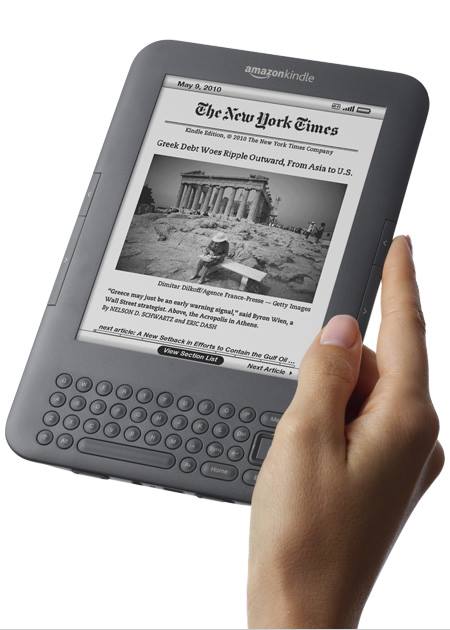
On this day in 2007, Amazon released the first Kindle e-reader, allowing users to download, browse, and ‪‎read ‎ebooks, newspapers, magazines, and other digital media.How has the e-reader affected the way that you read ‪‎books?
10600605_10152691408816336_7968604096780845313_n.jpg
From the Writer's Relief facebook page
I saw this post in my facebook feed this morning and stared at the picture for a while. The first kindle I ever held looked exactly like this one, only instead of gray it was white. It had belonged to my husband’s best friend, and he had cracked one corner of the screen (a small crack). So he offered it to us after he ordered a new one. It was still attached to his amazon account, though, and he had all the Dresden Files novels. Since I had already borrowed another friend’s collection of paperbacks to read them the first time, I read them again, and didn’t mind the screen’s cracked corner one bit. I enjoyed highlighting things, getting the definition of a word immediately, and adding notes (the full keyboard was very helpful for this). I’m sure JR enjoys his Tricia-annotated kindle versions of those books now.
Eventually, my husband and I went ahead and purchased our own kindles, to buy ebooks on our own amazon account. We got the cheapest versions, sans-keyboard, and I immediately re-read everything we owned by Jim Butcher so that our versions would have all my highlights and notes. It’s definitely harder to get my thoughts down when I only have an arrow key and “enter,” but the keyboardless version is more compact, and therefore less apt to get its screen cracked if you forgot it was in your back pocket. They’re still pretty delicate, and back-pocket storage is definitely not recommended. I can proudly say that I’m still using my first kindle, while my husband is on his third (admittedly, I was the one who cracked the screen of his first one. The second was all him).
These days, I use my kindle every single day. I reread old favorites and new favorites. I find free versions of classic books and enjoy those for the first time. My favorite thing to do is read a stack of books all at once, a chapter at a time. This is something I definitely can’t do with a hardback; there’s a copy of the Ultimate Hitchhiker’s Guide to the Galaxy next to my bed, but I’d never think of thumbing through it to find the next bit, reading only one chapter, and then putting it down so that I could read a chapter of something else. A tome that heavy has to stay in your lap.
I don’t think I would trade my kindle out for a newer version, unless it was going to be the paperwhite, or something that came with a light attached to the top so I could read it in the dark and not bother my light sensitive husband if I wanted to enjoy books late into the night. I don’t think I’ll ever need a device with a touch screen; buttons suit me just fine. And while it might be nice to have something small to watch movies on while I crochet from the comfort of my own bed, I really enjoy the way I use my kindle now: for books, and only for books.

Thursday, October 16, 2014

Thursday in History: The Library of Alexandria


It’s always too soon to joke about the destruction of the Library of Alexandria. One of the Wonders of the Ancient World, this place was amazing. It was built by Ptolemy I, the guy who took over ruling the Egyptian piece of Alexander the Great’s empire. The Library was full of innumerable scrolls which scholars from all over the place used to study when they came to research and learn at the Musaeum of Alexandria.
The Library may never have gained much fame had it not been destroyed, and all its works lost. There are differing accounts as to when the destruction happened: one romantic account has Marc Antony and Cleopatra perishing in one another’s arms as the Library burned around them; another says that Emperor Aurelian was putting down a revolt and accidentally damaged the area of the city where the library was located; and one blames the loss of the Library’s contents on Pope Theophilus. However it happened, all of those scrolls, all of that knowledge, that potential to learn, was lost. Wikipedia put it quite nicely: “though it is unknown how many scrolls were housed at any given time, their combined value was incalculable.”
That word: incalculable, is pretty descriptive. Whenever I think about the Library of Alexandria, I daydream about the kinds of things that were there, and what we might know today if it had not all been destroyed. It makes me sad. So yes, even though it’s kind of funny to say, I really do think that it’s always too soon to joke about the destruction of the Library of Alexandria.
The original Library didn't have a website. The new one does: bibalex.org
On this day in history in 2002, the gorgeously amazing piece of architecture which is blessed to be the modern installment of this ancient wonder of the world was officially inaugurated. It sits right on the Mediterranean, and has many interesting features: the largest reading room in the world, the Espresso Book Machine (which prints books for you right when you want them), and various specialized libraries and museum exhibits.
750,000 square feet of reading space on eleven levels. I wonder how far a "Shhh!" carries.
It may not be the wealth of information that its ancient counterpart once was, but maybe someday it will be. In the meantime, it is a breathtaking piece of architecture that symbolizes the hope that the world could build a library like the one in ancient Alexandria.

Wednesday, October 8, 2014

Sealed With a Kiss

I stared at her. “What are you doing?” I asked.
“Sealing this envelope,” she replied.
“Is it a love letter or something?” I asked.
She frowned at me. “It’s the cable bill.”
I glanced at the television. “I didn’t think our cable service was that great.”
She looked confused. “What, so I shouldn’t pay the bill?”
“No, but there’s really no need to make out with it before you send it.”
“Huh?”
I sighed and asked her the question I should have started with. “Why are you kissing that envelope?”
“I told you,” she said, exasperated. “I’m sealing it. That’s how you seal an envelope: with a kiss.”
I stared at her, not knowing quite what to say.
“Isn’t… that right?” she ventured.
I opened my mouth, then closed it to keep in the laughter that was bubbling near the surface.
“Look,” I said, a couple of minutes later. “I’m pretty sure we can pay the cable bill online.”

Tuesday, September 16, 2014

Pottermore!

When I was a kid, we had a computer. You’d turn it on, and the black and green screen would light up, waiting to be commanded with a MS-DOS prompt. The only thing my brothers and I would use it for was to play Snake, the classic game which everyone has played, and Gorilla, which was an early version of Worms (a game you can still get on the PSN and play on your brand new PS4), only instead of different weapons all you had was an exploding banana―and you had to enter coordinates to make the projectile land as close to your opponent as possible.
We moved on to bigger and better things later, such as Windows 3.1, and later, Windows 95. But all this amazing technology came with the alarming (to my mother, anyway) idea of better graphics and better games. I don’t know what kind of games other kids had, but we had some totally awesome math games (“tessellate; tessellate”), a Mother Goose game where you had to reunite items you found with the nursery rhyme they matched, a totally awesome spelling game that required you to navigate a dangerous arctic scene to collect the letters to a word (in the correct order!) followed by a quick spelling test.
But some of the coolest “games” we had were the interactive story books. We only had a couple of them: The Tortoise and the Hare and a few Arthur books (that I was really too old for). It was just like sitting down to read a regular book, except that no matter how you manhandled the pages of a book, the pictures wouldn’t move or make noises. Clicking on certain things in a Living Book made them move, or squeak, or run away. It was always fun to poke around at the pictures to see what would happen, and if you got bored doing that, the words of the story were on every page, and you could click every single one. Even though I already knew how to read and thought the stories were kind of silly, discovering all the silly things you could do was really fun.
The Pottermore logo, which I found on the wiki.
J.K. Rowling made sure that her Harry Potter website Pottermore would be fun for fans of all ages. The interactive scenes from the books have things to click on and hidden items to collect, but it doesn’t read you the entire book from start to finish. Instead, you are encouraged to read the book while you enjoy Pottermore. It reminds me of those Living Books from when I was a kid, but the interactive scenes aren’t all there is to Pottermore!
As you follow Harry through the story, you get to experience things as he experiences them. Not only does it mean that you get to watch Hagrid knock down the door of the Hut on the Rock, but it also means that you get to visit Ollivander’s, and take a quiz that gets you your own wand. It means that you get to open Chocolate Frog cards with Ron on the Hogwarts Express and nervously wait your turn to get sorted (another quiz).
After that, you can start to earn points for your house. This is done by finding items in teh interactive scenes, brewing potions (which, as a Ravenclaw, I am particularly good at), and duelling (which I am horrible at).
Pottermore is a fan experience, not a social network. Sure, you have a friends list and can add whomever you like to it. But you can’t post pictures or even choose your own screen name. Since many Harry Potter fans are children, Rowling made sure that Pottermore would be a safe and courteous place for everyone. When you sign up, you get to choose from a short list of Potterish screen names; no one on Pottermore is “RudeDude420,” instead we all have names like “QuillSnitch,” “WildMoonstone,” and “BronzeMahogany.” And while there are plenty of places to write comments, anyone who is rude or vulgar is immediately “asked to leave.”
The Ravenclaw crest
(which I also found on the wiki)
I get an email from the website periodically, whenever more scenes are added or a major event is about to take place. Today I got a reminder that the House Cup will soon be awarded. Hufflepuff is leading Ravenclaw by 200,000 points, so I need to get to brewing some potions and finding some items (and avoiding the duelling club, where I would only give away points to my opponents).
Pottermore is just fun (whether or not I can help win the House Cup). It’s a safe, enjoyable environment where I can have a good time with fellow fans. And it reminds me of the awesome games I played as a kid.
If you like Harry Potter, or interactive story books, or both, I highly recommend Pottermore. Come get sorted into Ravenclaw and help us take the House Cup!

Monday, September 15, 2014

Writing About Writing

It’s very easy for me, especially on the days that I can’t immediately think of something to write about, to let my attention wander on the internet. Sometimes it’s a good thing, because I will occasionally get inspired by a news article, or an argument about something random, or by the contents of a webcomic. Other times I will spend several hours reading the webcomic’s archives and floating in a state of non-working bliss.
Usually it’s the guilty thought of “I HAVEN’T WRITTEN ANYTHING TODAY” that pulls me back to doing what I actually should be doing, but occasionally I come across things like this.
Image property of The Oatmeal.
Earlier today I thought several witty things and amused myself, and found myself thinking, “if only I could draw, I wouldn’t have to write everything down; it would be less work.” Then I read this comic and realized that when you can draw, not only do you have to do the drawing part, but you also have to do the writing part. So really, not being able to draw is a good thing (if I’m looking at the less/more work scale).
Sometimes the only thing you can do when you’re in a state of “I’ve got nothin’” is to write about writing. You might think that “writing about writing” is the same thing as “writing about nothing,” but it’s surprising how stepping back to take a look at what you do will produce a wonderful piece. This comic, like most by The Oatmeal, is endearingly rude and half full of swears, but makes amazing and inspiring points.
As a writer, I get to make my own schedule. For me, this means that once I write something sufficiently amusing, I can do whatever I want for the rest of the day. Play video games, ignore housework, nap, whatever. Once I click that ‘publish’ button, my day is my own.
Every job has its faults, and even though this is my dream job, I still feel like complaining about it sometimes… just not to my wonderful husband who actually has real reasons to complain about his job. “I couldn’t think of anything to write” is such a lame thing to whine about in the face of his actual hardships that I’d rather write something I wasn’t happy with than admit that aloud to him. My husband is awesome.
I love the freedom of being able to write whatever I want. I remember being in school and chafing at ridiculous assignments that I had no interesting creative ideas for, and then feeling like I was set free to romp in a field whenever the assignment happened to be “write whatever you want.” Today it seems like it’s almost opposite. A day full of hours of promise, glistening with the freedom of writing whatever I want seems like oppression, but an interesting phrase, a few words, or an inspiring image can give me the structure I need to creatively produce something amazing.
Sometimes I wish there was an idea generator for the days I when can’t think of anything, a machine without feelings capable of being hurt that I could just push a button as many times as I needed to find something that inspired me. It would be better than playing the writing equivalent of “what do you want for dinner” with my friends. “What should I write about?” “Um, how about…?” “No, that sounds boring.” I suspect that when I inflict that sort of thing on myself and others that deep down I really just want to tell someone else that “your ideas are bad and you should feel bad.” Maybe it somehow makes me feel better? After all, when that situation comes up, I can’t think of anything good, so I suppose it comforts me to know that no one else can either.
An inspiration isn’t something you can control. When I get inspired (usually by a writing prompt of some kind), I can’t turn it off or walk away from it. If I sleep on an idea (or a story), it’s really hard to get that inspiration back. Several times I have ended up working late into the night on something because I knew that if I stopped, I would never be able to come back to it. “What? You want dinner? Well, I started thawing some chicken a couple of hours ago and the recipe I was going to use is sitting on the kitchen counter. Good luck with that; hope the kids like it.”
Cultivating seeds of ideas is sometimes difficult for me. Something funny will happen, or I’ll start pondering a situation and see the interesting or amusing things about it. The smart thing to do, you’d think, would be to write these ideas down somewhere so that later I can come back and use them when I needed to. And I’ve got one of those ‘somewhere’s, a google doc named “stuff to blog about” or some such. But I’ve found that sometimes, writing down that idea before it’s ready can kill it (or make me lose interest in it), just like planting a seedling in the ground ground outside too early. If it’s really a great idea, it will tumble around in my brain for long enough that eventually it will make its way out.
“Make a new friend,” The Oatmeal encourages near the end. “Learn to chainsaw juggle. Read a book. Go hang gliding in your underpants. If you have done all these things and you still don’t have anything to write about, then you shouldn’t be a writer. ...if you don’t have anything to say, then you shouldn’t be talking. And if you don’t have anything to write about, don’t write.”
It’s not like I don’t have things to write about. It’s just one of those moods you get in sometimes, like when you’re eleven and sitting in the middle of your room, surrounded by toys, and whining at your mom: “I’m bored.” I’ve got stuff to write about. I just started reading that cool Rothfuss series (Name of the Wind); there’s a rad spider who’s been living on our front porch for a week or so (I’ve been thinking about ways to start charging him rent, but I’m not sure how I’d monetize slightly digested insect carcasses); and my kids constantly pretend to be dinosaurs. There’s a wealth of stuff going on around here.
It’s hard to get rid of that mood, when you feel uninspired and that there’s nothing interesting enough going on in your life to share with your readers. So when in doubt, write about writing. You may discover that you’ve got quite a bit to write about after all.

Monday, September 8, 2014

Traffic Light Speculation

I’m pretty good at spinning fiction on the fly. I’m not bragging about being an amazing liar, but rather saying that I enjoy coming up with plausible reasons for the behavior of others, such as: “Maybe she wore those six inch banana yellow heels because she needed the height so that her dress wouldn’t drag on the floor and figured that its length would cover them up.” My husband is hardly ever curious enough about the thought processes of others to formulate theories, and so I was surprised last week on our way home from our Labor Day vacation when he explained why another motorist ran a red light.
The intersection at 17th and O Street is not the place to blast through a very very red light. 17th isn’t as busy as O, but it’s got a fair amount of traffic. That’s why I was baffled when a guy in a red car just nonchalantly zipped through the intersection down O Street. “What’s his problem?” I asked rhetorically, as I watched the several other cars that had been going down 17th Street carefully avoid him.
“He’s probably color blind,” my husband explained immediately. “The lights in this city are horizontal, and he’s probably from out of town.”
I stared at him. “What?”
“If he’s color blind and from out of town, there’s no way for him to know whether the light is green or red. This town should have vertical traffic lights.”
I frowned and googled it.
Traffic light perception (from inovasolutions.com)
Lincoln does have a few intersections with vertical traffic lights (red on the top, yellow in the middle, green on the bottom), but many of them are horizontal. In some of the newer ones, the green lights are a little bluer, which helps those who are color blind differentiate more easily, but city workers aren’t running around replacing all the green lights with blue/green ones. Apparently changing every traffic light in the city to make them safer for around ten percent of the population would be expensive.
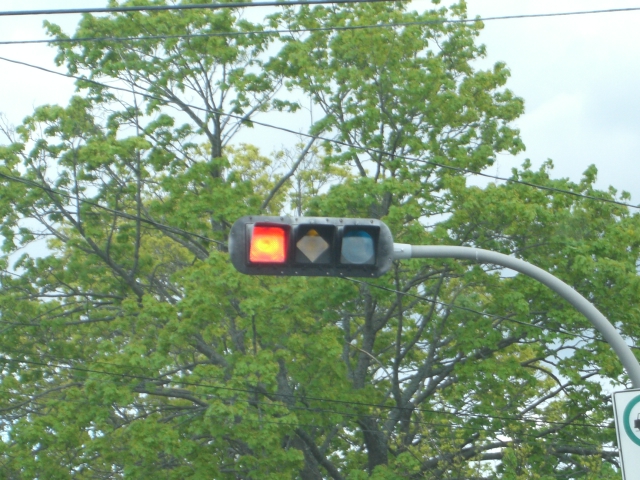
Halifax horizontal traffic light
(by Sprocket, via wikipedia)
Other cities primarily use vertical traffic lights. In Halifax, Nova Scotia, the lights on a horizontal traffic light are different shapes. The red is a square, the yellow a diamond, and the green a circle. In countries where we drive on the right side of the road, horizontal traffic lights go from left to right: red on the left, yellow in the middle, green on the right. Red and green are swapped where they drive on the left side of the road. So if that guy ran the red light on O Street because he was color blind and thought it was green, he was from way, way out of town.
Or, maybe he was a professional low-speed daredevil who specialized in stunts of this nature, and this one was just the newest in a series of disregarded red lights to get in the Guinness Book of World Records for Most Red Lights Run Without Causing An Accident.

Thursday, September 4, 2014

Thursday in History: A Historically Significant List

Wikipedia is funny. It’s got tons of information on tons of different things, so it’s usually a good place to go to find some information. Every Thursday I search the day and look at some of the things that happened on that day in history. I pick something interesting, or look for patterns of several related interesting things. On a slow day, I have to scroll down to the holidays, and on an even slower day, I scroll through the births and deaths to look for a well known name, hoping to write about an interesting person’s life (or death).
On this day in history in 2014, I searched “September 4” on wikipedia, and found a wealth of interesting things. A couple of deposings (a Roman Emperor―the end of the Western Roman Empire, Napoleon III―the end of the Second Empire of Napoleon), treaties signed, the beginning of the electrical age, disastrous plane crashes, important wartime occurrences, and the birthdays of several different important things, such as Google, Kodak, and the city of Los Angeles.
Also, in 1995, WCW Monday Nitro made its debut on TNT.
If it’s important to somebody, it’s probably on wikipedia. And just because it’s important to some people, doesn’t mean it’s going to be important to everyone. Every day is historically significant in its own way to different people. To some, today will be remembered as the day that Arkansas’ governor summoned the National Guard to stop nine students from enrolling in high school. And others will be celebrating the television debut of “professional” “wrestling.” Although I may be able to easily see which of those two events is more historically significant, I don’t have any information on how many lives may have been changed for the better by Monday Nitro.
Wikipedia is funny. It’s full of information about things that are important (historically or otherwise) and it’s a great place to start researching pretty much anything. Though when you do, you should remember that while it may have the accurate information you need on the 2010 New Zealand earthquake, it’s also got plenty of other stuff. And it will put all of that stuff on a list with other things that continue to have an impact on the world’s population, even if they happened centuries ago.
So let’s all remember September 4th, the day when empires fell, monarchs rose, and brave soldiers fought and for the future of their countries and the world. Oh, and when Ted Turner brought a new show featuring shouting and big muscles to TNT to rival the one on USA Network. That should go without saying.

Tuesday, June 10, 2014

Ode to the Keyboard

Ahh, a keyboard. You can keep your tablets and your touch screen smartphones. Voice to text doesn’t cut it for me, and even setting pencil to page isn’t as fast as my fingers on the keys. For me, it’s the closest thing from brain to screen.
I can live without a mouse, without a great speaker system, and even without a pristine, unspoiled monitor. I don’t care how many broken pixels there are: just give me a keyboard!
It’s so much easier to be inspired when I know I don’t have to wait long for my ideas to take shape in words. When the words can flow out my fingers, writing no longer seems like a chore, and I can let myself be creative at whatever pace that creativity takes.
Dear Keyboard, I love you. Don’t ever change.

Tuesday, April 1, 2014

It's Time

It’s not looking so great lately.
Usually it just sits there, making a wheezing sound.
Sometimes, I come in to find it completely silent, and it takes me quite a while to rouse it.
It might be… time.
I’ve been through this before, and it’s always so painful. This one does all the tricks I like. It’s used to me, and I’m used to it. When I get a new one, I’ll have to get used to its personality. There’s no way it’ll be the same.
I don’t want it to be time!
I love my computer!

Tuesday, February 4, 2014

ANYTHING BUT THE CAPS LOCK

I’ve got some… feelings. About a certain key on my keyboard. We don’t really think about the keys on our keyboards much, we just expect them to work and be there when we need them. And we need them a lot more often than we realize. One particular key is quite necessary to me, but Google disagrees. Their new laptop will replace it with a search button.
My only reaction to their decision to do away with the caps lock key is “NOOOOOOOOOOOOOOOO!”
I need caps lock. How else will I type things like “NOOOOOOOOOOOOOOOO!”? I don’t care that it’s just a dinosaur left over from typewriter days. I use it ALL THE TIME. How am I supposed to shout at people on the internet without it? SOME DAYS, PEOPLE ON THE INTERNET NEED TO BE SHOUTED AT.
There are plenty of ways for me to search online. Open a new tab and type something. Open a new tab and speak to my computer. ...Okay, maybe not plenty of ways, but my options for searching work, and I use them every day, multiple times per day!
I even have a caps lock on the keyboard on my phone. IT IS NECESSARY TO ME.
So my question for you, Google, is “WHY, WHY???” Take anything but that! Take the tilde~ who uses a tilde?! Or take that line thing that nobody knows the purpose of | and move your backslash \ someplace else. Or put a shift key on only one side and move the caps lock down to that space on the other side to make room for your search key.
DON’T TAKE THE CAPS LOCK; ANYTHING BUT THE CAPS LOCK.

Tuesday, January 28, 2014

Hesitance

I’m old enough to remember hand writing papers for high school. Sometimes I typed them up and printed them, but I didn’t start doing that exclusively until college. Today, I hardly write anything on paper, since the place I need it to be is on the computer anyway.
I use Google Drive to store my documents. All of them. Hardly any of my writing is stored on my computer’s hard drive, and the reason is simple: I don’t trust it.
Those three heartbeats worth of blind panic when you’re not daring to breathe as though that would bring back your lost file is not a moment that I enjoy living through. I’ve lost plenty of homework and personal writing work because the computer I was working on decided to die forever.
That Vader-esque “NOOOOOOO” feeling is not pleasant, nor is the look on the professor’s face when you’re asking for an extension to re-write what your computer lost, the one that is trying to decide whether the bags under your eyes are there because you waited until the last minute (and let’s face it, you did) or if they are truly evidence of your frustration with the faith which you put in your computer.
So my reluctance to use a writing program that stores things on my hard drive instead of my computer is understandable. I’ve heard that Scrivener is a really great program. It certainly looks interesting, with its vows to organize everything from various projects and its zillions of folders, but I’m still hesitant.
One thing I know I can’t do with Scrivener is easily share something online. And I can’t work on a problem sentence in the same document at the same time as my writing partner. Those are things I can do in with Google Drive.
I’m happy with the way I work. Learning a whole new software program seems like a lot of work for who knows how much gain. And what if my computer dies and loses all of everything? There’s no ‘undo’ button for a crashed hard drive.
I’m not sure about Scrivener yet. We’ll see… I’ll reserve judgement for when I’m done with this 80 page tutorial.

Thursday, January 16, 2014

Thursday in History: First Post

On this day in history in 1986, a group of engineers met for the first time for the express purpose of making the internet run better. They were volunteers, and dedicated themselves to improving the internet from an engineering standpoint. Meetings are held three times per year, and are open to the public, so anyone can attend and contribute.
The Internet Engineering Task Force is dedicated to making the internet a better place… from an engineering standpoint. “We try to avoid policy and business questions, as much as possible,” says their Newcomers page at ietf.org. “If you're interested in these general aspects, consider joining the Internet Society.” Translation: “We’re engineers doing engineering. Go away and leave us alone unless you’re interested in engineering with us!”
The Internet Society was created to support the Internet Engineering Task Force: someone to answer people’s questions so that the engineers could concentrate on engineering. The engineers of the IETF work, and the Internet Society does the paperwork.
Happy Anniversary, Internet! It’s nice to know there are actually some people in the world working to make you a better place.

Thursday, January 9, 2014

Thursday in History: Pix

Today, every single person carries a device around with them that can, among many other things, capture an image of a moment. But this wouldn't be possible if it weren't for the groundwork that was laid for it by French artist Louis Daguerre and his partner, inventor Nicéphore Niépce.
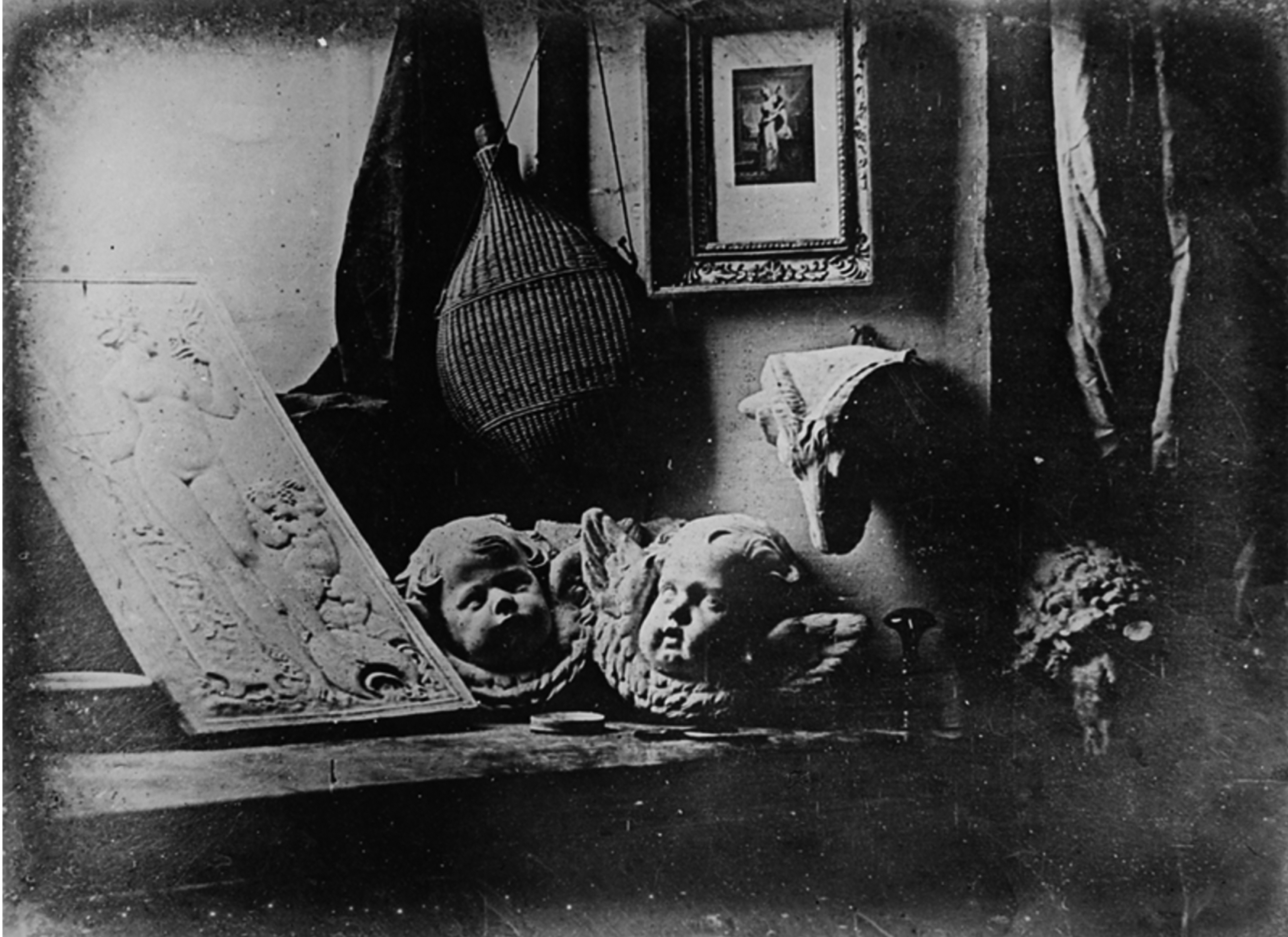
The first daguerreotype, taken by Daguerre himself in 1837
(via wikipedia)
On this day in history in 1839, the French Academy of Sciences announced the birth of photography: the invention of the Daguerreotype. In order to capture an image, the subject had to sit still for fifteen minutes. This was followed by a long, arduous process involving various chemicals and treating methods, after which the image had to be kept in a case under glass to prevent the image from flaking away.
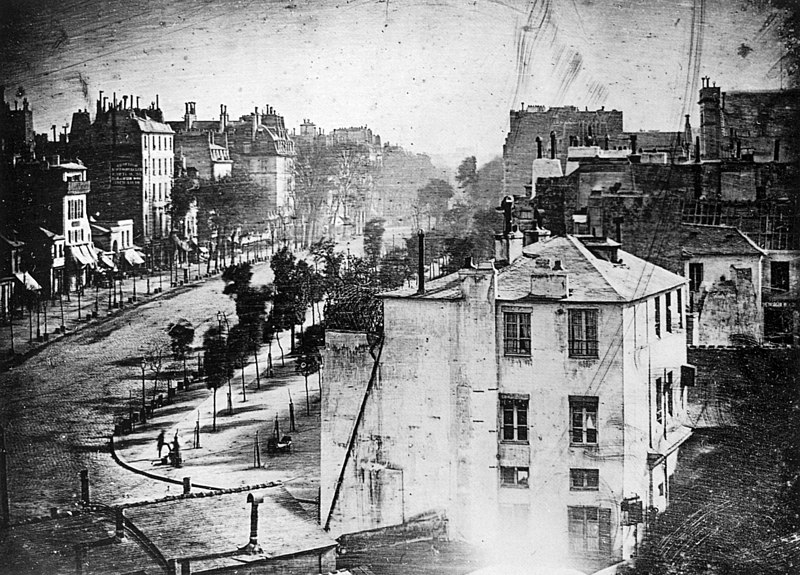
The first picture of a person was taken by Daguerre himself. The scene outside his window was of a busy street in Paris, the Boulevard du Temple. The desertedness of the image is a lie: traffic was as thick as ever, but none of the carriages were still long enough to be captured on film. The men in the lower left, however, were.
The Boulevard du Temple in Paris; the first photograph of a living human, taken by Louis Daguerre in 1838. (via wikipedia)
Daguerreotype usage dropped off in the 1860s, when newer, easier ways of capturing images began to be invented. In the 1980s and 90s, however, artists began to become interested in it again, and daguerreotyping revived. There are less than one hundred daguerreotypes in the world today, and you can find their gorgeous works using this interesting antique medium at CDags.org.

Wednesday, October 2, 2013

Writing Prompt: The Girl From the Floating Forest

Writing Prompt #770

The moment I saw her, I knew she was the one. I wonder how many other people have experienced love at first sight on the streets of Manhattan. I’d wager that it’s not a small number, but how many of them have fallen in love with a street performer? At least, I thought she was a street performer. Her strange attire, wild hair, and wild eyes drew me to her in a way that no one else ever had.
Normally I wouldn’t just ask out someone off the street, but I figured that she probably got offers to take her out to dinner or grab a cup of coffee all the time. The worst she could do was say no, right? So I said, “Hey, would you like to go get a drink with me when you’re finished… working?”
“Seriously?” said a busker nearby who had his guitar case open in front of him. “That chick is crazy. Earlier she tore a fifty in half when a tourist gave it to her. She’s not even doing anything!”
She was doing something, in fact, she had been climbing a tree when I asked her out, and she leaped down from it, and addressed the man with the guitar. “You are very rude,” she said, “though your lute is pleasing to listen to.” The busker gave her a look that would have offended anyone else, but she had already turned away from him and was looking at me. “Where else would we go if we needed to drink?” she asked, pointing at the fountain. “There is plenty of water here.”
I made a face. “I don’t think--” I began.
“You believe it is not potable?” she interrupted. “I tested it earlier, and it appears to be so, although I am sure it would be more refreshing if those passing by would stop throwing those metal pieces into it.” She gestured at the coins in the guitar case.
I had to stop myself from laughing. “I meant more like a glass of wine, or, you know, water if you want, I guess. Cleaner water than this.”
She tilted her shoulder in a capitulating gesture and began to walk away, then turned and said, “You had better lead us. I do not know the way.”
“I’m David,” I said, as we walked across Bryant Park toward Fifth Avenue. I held out my hand to shake hers, but instead she slapped the back of her hand on my palm and went back to looking at the trees.
“I am called Tiarr,” she replied.
“Tiara?” I said, miming one on my head. “Like a crown?”
She glanced sideways at me. “I do not wear a crown,” she said. “My grandfather, is, however, the current leader of our people.”
I didn’t know if she was joking or just really into her act, but one of the things I have learned in my twenty five years on this planet is to not laugh at a woman when she wants to be taken seriously. It didn’t stop me from smiling, though. “So you’re not from around here, then? What brings you to New York?”
“Exploration,” she replied, inspecting the front of the library as we rounded the corner. She grabbed my arm. “What do those beasts guard?”
I hadn’t yet processed her answer to my question, so I was not prepared for her question. “Uh, the lions? It’s… this is the library. There are books inside.”
“Books!” she declared. “Does it also by any chance contain a repository of nautical charts? My people have been looking for the island of Utopia for generations.”
“Utopia?”
“Yes, a copy was given to one of my ancestors long ago and we have been looking for the place ever since.”
“Thomas More… that’s... political satire. It’s not a real place. Have you ever read Gulliver’s Travels or Dante’s Inferno? It’s the same type of thing. The authors make up places and things to insult their political enemies.”
She scrunched up her face in confusion. ”Why not just kill them?”
I smiled. “Because even though the authors of those books have been dead for centuries, we still know the names of the men they hated.”
“Thank you,” she said. “That is valuable information.”
“You’re welcome,” I said, still amused. I glanced at my watch. “If you don’t mind walking, there’s a place on West 35th that’s a favorite of mine. Would you like to go there?”
Instead of answering, she stared at my wrist. “What function does that device have? People seem to have many different types of devices on this island.”
“Uh, this is my watch,” I told her, showing off the cheap but sturdy plastic I wore every day along with my cheap but sturdy suit. “It tells the time.”
She held on to my forearm and hand as we crossed the street in order to inspect it. “Instead of looking at the sky, you have a device that tells you something that you could learn by seeing. Is that why you call it a ‘watch?’”
“I hadn’t ever thought of it that way before,” I said. “That might be the origin of the name. I’m not sure.”
We walked down Fifth Avenue, and she asked enough questions about everyday items that I was almost convinced that she was an explorer instead of just an energetic actress way too into her part, and I felt more like I was giving a walking tour than a guy going on a date. I had to explain how a telephone worked, what earbuds were for, give reasons for why someone would send a text, and tell her what the internet was before we got near our destination, and we had just begun a conversation about how all these things could be used with and accessed from the same device when she suddenly began to jump up and down and point down the street.
“I want to go there!” she said. “I would like to ascend one of your structures.”
It wasn’t sexual innuendo. We were in the shadow of the Empire State Building. So I forgot about drinks and we stood in line and shuffled into the elevator with a bunch of other tourists. I didn’t mind it much when Tiarr jumped on me as soon as we started heading up. I had given her lots of details about the mechanics of elevators, but she still didn’t quite grasp what I had been trying to convey, and anyway someone’s first time on an elevator is bound to be startling no matter how well they understand how it works.
“You are sure it is mechanics and not sorcery,” she said several times as we ascended.
I assured her it was, then told the lady that giving us an odd look, “She’s a time traveler from the past.” Everyone laughed, the elevator attendant rolled his eyes, and Tiarr glared at me.
As soon as we arrived in the gift shop, Tiarr reminded me that she was “an explorer, not a crazy person.”
I found myself grinning and going along with whatever fantasy or game she was playing. “I know,” I said, grabbing her hand to pull her outside, “but the authorities here don’t approve of explorers. If someone reported you, you might be captured and held for questioning.”
“That would be inconvenient,” she admitted, then gasped and stepped back as she reached the edge of the building and looked out over the city. “Why are all of your structures so tall?”
“It’s a small island,” I said, pointing at the East River and the Hudson, both clearly visible from where we stood.
“Instead of the population remaining small, your people have utilized the ability to raise these structures in order to accommodate more people?”
I nodded. “And not just here. There are large cities and tall buildings all over the country.”
Tiarr smiled. It made her already beautiful face even more appealing. “Thank you, David. You have been a very helpful and useful guide.”
“You’re welcome,” I said. “This has definitely been an interesting experience.”
A gust of autumn wind at 86 stories brushed past us, leaving Tiarr shivering in her short tanktop-like shirt and trousers that cut off below the knee. I offered her my meager suit jacket, which she accepted after watching another couple, who actually were on a date, do the same thing. Then she surprised me by standing on her tiptoes and giving me a kiss.
While I stood, shocked at her amorous behavior, she thanked me and stepped back to put on my jacket, apparently sizing up its warmth-giving possibilities. I was about to ask about the kiss, but then out of the corner of my eye, I saw that the couple that Tiarr had observed were making out, and realized that maybe she thought that she was exchanging the kiss for the jacket.
“Are we doing that now?” she asked, interrupting my thoughts. She had noticed me watching the couple.
“Uh… no,” I said, blushing. “Not… unless you want to.”
Tiarr shifted her shoulder in a shrug-like motion. “Perhaps later.” She strolled along the observation deck, seeming as though she was intent on seeing as much of the surrounding area as she could.
“So you never told me where you were from,” I reminded her as we walked.
She paused in her survey of the area to flash a grin at me. “You would not believe me if I told you,” she answered.
“What, are you really from the past or something? A different planet? Dinotopia?”
She laughed. “More nonexistent places from your political satire?” I wasn’t quite sure how to respond to that, so I just laughed with her. As we reached the southwestern corner of the building, she seized my hand and pointed out toward the water. “See that green patch?” she asked. I couldn’t. “That is where I’m from.”
“Lost underwater Kingdom of Atlantis?” I guessed.
“No,” she said, “a floating forest.”
“O...kay,” I said.
“I told you that you wouldn’t believe me,” she said, smirking.
She didn’t seem terribly offended about it, at least not enough to strand me at the top of the Empire State Building without my suit jacket. After a while we descended, I bought us some food from a street vendor, and we walked in the general direction of Brooklyn.
Tiarr mimicked my movements while we ate, acting as though she’d never eaten a hot dog before. “This does not seem to provide much sustenance,” she observed, “but it is not unpleasant.”
"You must be more used to, uh... what do you eat on a floating forest?"
"Lots of seafood," she replied, licking mustard off her hand.
She asked me more questions about technology and Manhattan, some about my home (a tiny apartment that I shared with roommates who hated me) and work (a lousy nine to five that I'd been planning to quit for years), and even a few about the government and the world economy. Finally, when we reached the East River Esplanade, I realized I hadn't been directing the walk.
“You know where you’re headed?” I asked her.
She nodded. “Home.”
That’s when I saw it.
When she told me she lived in a floating forest, I thought she was crazy. But no, there it was, just like she said.
I looked around at the other people around who were, like us, taking an evening stroll. Why couldn’t they see the huge, ancient ship with trees growing everywhere on it that was just drifting quietly down the river? Why hadn’t it been on the news? I looked to Tiarr for answers, and I found her smiling knowingly.
“It is surprising how often people ignore something because it does not fit into the way they view the world,” she said.
I could only gape in response.
“Thank you for your assistance today, David. I do not think I would have learned so much were it not for you. Would you like your garment back?” Before I could answer, she took off my jacket and handed it to me. “Goodbye,” she said, and dove into the river.
"Wait!" I yelled, as I dashed after her. My chest hit the railing and I squinted out over the water for some sign of her. She surfaced and tossed her hair back off of her face. "Will I ever see you again?"
Her laugh floated to me on the breeze. "Only if you come with me!" she shouted.
I learned a lot that day. I learned that people aren't always what they seem to be. I learned that just because I don't believe that something exists doesn't mean that it's a fantasy. And I learned that the East River is cold.