Friday, September 12, 2014

Tuft Pile

There are a lot of stages to tiny owl production. There's the picking out yarn stage, the tiny owl making stage, the revisiting the pattern so I can remember how to make the square stage, the eye making stage, the button sewing stage, the attaching stage, and the tuft pile stage.
My least favorite stage in any project is the "fasten off; weave in ends" stage, because no matter what I do, the ends never stay weaved-in. Maybe I'm doing it wrong, but any project I've ever gotten any use out of after I was finished with it (blankets, hoodies for the kids) has un-weaved its ends of its own volition, no matter how hard I tried to make sure that the stupid yarn stayed put.
I'm not really expecting any of the tiny owls to actually keep any of their many multiple ends tucked in, but it's fun to try, and always fun to watch the tuft pile grow when it's time to trim those many multiple ends.

Thursday, September 11, 2014

Thursday in History: Coincidence and Conspiracy

With the recent Sherlock craze sweeping the world, a while back Amazon offered a free kindle version of all of Arthur Conan Doyle’s works on Holmes. I’m sure I was one of many who snapped up the opportunity, but I’m not sure how many actually got through them all. I’m not saying that they’re not well written or interesting, it’s just that there are certain times when ACD kind of just… starts telling a different story. Right in the middle of the one you were interested in. He would usually bring it back around and link it to the story he’d already been telling, but occasionally it was like “um… why should I care about this?”
For instance, in A Study in Scarlet (that’s A Study in Pink for you BBC Cumberbatch/Freeman lovers), Holmes cunningly catches the bad guy, and promises to explain everything, after which the story suddenly becomes a novella about how a group of Mormons rescues a pair of travelers who had no hope for their own survival. And the reader is like, “uh… what does this have to do with anything?!” Eventually it has everything to do with it, but leaves you going, “dude, I think that may have been too much back story.”
In Valley of Fear, Holmes focuses on draining the moat (yes, a moat) around the home of a brutally murdered man, only to have the man himself come forward to confess that the corpse was that of the attempted murderer, and that he had reacted in self defense, which included dressing his attacker in his own clothes to deter any further attempts. When the question of why the murder was attempted in the first place is asked, the reader is then treated to a novel-length interruption about a young man who moves into a new area and joins a guild that he had been a member of in another town. (ACD, who was a Freemason himself, changed the name of the guild to “Freemen,” presumably so he wouldn’t be sued or maybe killed by fellow guild members.) Another character tries to warn him, “dude, those guys are bad news in these here parts,” but he doesn’t listen. In fact, he doesn’t seem to mind. He joins in their bullying of various people in the surrounding area, eventually becoming one of the highest ranking members. When the guildmaster begins to hear rumors about investigation, the young man swears he’ll get to the bottom of it. After gathering all the guild’s heavy hitters in his apartment to spring a trap on the investigator and police, he springs another: he was a mole, and it was his job to make sure that he had enough evidence to send all the men he had gathered to jail. As a result, the other members of the guild (and the men who were eventually released from jail) had been chasing him ever since (which was presumably why he’d ended up buying a house with a moat).
On this day in history in 1826 a Freemason by the name of William Morgan was arrested for “debt.” He had actually trained as a stone worker and had joined the Masons in Rochester, New York.
See, guilds in ancient times were unions. You could refuse to pay one bricklayer his decent wage, but when a screaming mob of them demanded fair compensation, there wasn't much you could do but give it to them.
Another role that guilds filled was an after-work club: just dudes, sitting around when their work was finished, griping about it. Like a gathering of Starbucks baristas complaining about picky customers.
Morgan had moved his family to Batavia, New York and attempted to join the local Freemasons, and went off the handle a little when they denied him. “I’m totally going to write a book about all the Freemason secrets,” he boasted, “and I’ve already got a publisher and everything and we’re gonna make tons of money and high five each other, and then you’ll be sorry you didn’t let me in!”
The Freemasons in Batavia must have had some pretty dark secrets, because things got a little nuts. Somebody put up an anti-Morgan advertisement. There were reports that certain individuals attempted to burn down his publisher’s office. And then, Morgan was arrested. His publisher went to bail him out, and after that… Morgan disappeared. Morgan's widow married again and moved west with her new husband, where they joined the Church of the Latter Day Saints.
There are many theories about Morgan’s disappearance. Was he killed? (The body that washed up on the shore of Lake Ontario a year later was buried under his name, but the distraught widow of another man claimed that the clothes belonged to her husband.) Did he flee the country? (The Cayman Islands were nice in those days, as long as they weren’t hanging you for piracy.) Did the Freemasons drop $500 just so that Morgan would get himself out of the picture?
If they did, they wasted their cash; Morgan's publisher made tons after the book Morgan wrote became a bestseller. It was even one of the factors that sparked the creation of the Anti-Mason Party, who ran a presidential candidate against Andrew Jackson in 1832.
What really happened to William Morgan? Was his story fabricated as a tool for the anti-Masonic movement? Did he live out his life in foreign parts under a false name? Or was he killed by some angry Masons who hoped to silence him? Perhaps the whole thing was merely a conspiracy.
Nearly a century later, Arthur Conan Doyle wrote about similar circumstances. And today, there’s a television show based on his works, starring an actor whose last name is Freeman.
Coincidence? Or… conspiracy?

Wednesday, September 10, 2014

Only One

Ever lost a sock in the dryer? It's a pain to do the laundry afterward, because you’re like, “why do I only have one orange sock? What happened to the other one?” Not to mention the awkward looks you get at parties when you’re wearing two different socks. And don’t even try to pass it off as the new craze; everyone can see that you just lost one and won’t give up wearing the one you still have.
But what can you do when this happens?
I like to drive with my shoes off sometimes. But I’d never be able to get inside without putting them back on. So this situation was not an accident. Either someone was changing their shoes in the car and left this one by the door and it fell out, or a drunk passenger didn’t notice she’d lost some footwear, or someone’s boyfriend thought he’d be cute and threw it out the window (it can happen; though the worst my husband has ever done is toss my shoe a retrievable distance away under a nearby table at Outback Steakhouse). This street/shoe scene was completely human-at-fault and therefore the previous owner of the shoe does not deserve your pity. Feel free to take as many pictures of the shoe as you want.
It’s not like the street is going to start absorbing shoes anytime soon. It’s not nearly as sneaky as the dryer.

Tuesday, September 9, 2014

That Time UPS Delivered Stuff to My House Twice in One Day

There are several ways to gain entrance to my house. Six, in fact (not counting several convenient but unorthodox window options). There are several ways to gain the attention of the inhabitants of my house if you need to gain admittance, or, if, say, it is your job to place items into the hands of said inhabitants. Conveniently, these attention-getting devices are all placed right next to the most obvious entrance, all in an easy-to-see row.
There are two electric doorbells and an old fashioned crank doorbell that sounds like the ringing of the rotary phone that we had when I was a kid. It’s fun to ring. My kids do it all the time.
So say that you were, for example, a person whose livelihood depended on your timely taking various things to various locations and placing these things into the hands of people waiting for them. How would you gain the attention of the inhabitants of my house?
Obviously the answer is: show up first thing in the morning and bash your fist on the side of the house Big Bad Wolf style. Why use any conveniently placed attention-getters? Then, before any baffled inhabitants can stumble awake Chicken Little style (“The sky is falling! It’s the end of the world as we know it!”), abandon the most obvious entrance and brave the broken stairs up to the second floor by the side of the house to battering ram on that door. By the time you get back safely to the ground, the baffled inhabitants are sure to have pants on and be ready to receive the package that was so important it was necessary to stage the audio equivalent of World War III.
“That staircase is not a good idea,” I sleepily admonished as I opened the door, “and… there are doorbells right there,” I gestured two inches to my right with the package he had thrust into my hands.
If you loved your job enough to put forth that much effort to gain the attention of the inhabitants of a house, how would you respond? Would you say, “I’ll keep that in mind, thanks for the tip.” Would you say, “Oh, wow, I totally didn’t see them; sorry for startling you.” Or would you say in an annoyed tone, “Does the person on the label live here? Good, that’s all I need to know,” and walk away? (He’d already started out the morning with a Big Bad Wolf motif, he probably just figured he should end with some huffing and puffing.)
Since I was already up, I went about my day, slowly recovering from the shell-shock of being violently frightened awake.
That afternoon, the doorbell rang.
Surprisingly, it got my attention.
I went to the door and saw a package sitting on the threshold and a different brown-uniformed person than the one who had launched an attack on my home that morning walking toward a big truck idling on the street.
“Ringing the doorbell; what a strange idea!” I exclaimed to myself as I picked up the package.
“What?” the UPS guy called, turning around.
“Thank you!” I yelled back, giving him a wave.
“You’re welcome!” he said, waving back.
I’ll let you guess which interaction I preferred.
Maybe the next time we move it’ll have to be into a house with a huge, obvious doorbell, maybe with a big blinking sign to make sure no one misses it. Although, I guess since no UPS person has missed our normal doorbells since, maybe we should just make sure to move into a house made of brick.

Monday, September 8, 2014

Traffic Light Speculation

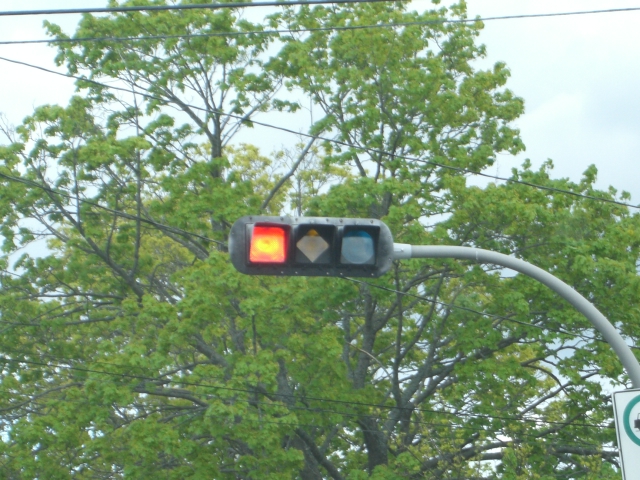
I’m pretty good at spinning fiction on the fly. I’m not bragging about being an amazing liar, but rather saying that I enjoy coming up with plausible reasons for the behavior of others, such as: “Maybe she wore those six inch banana yellow heels because she needed the height so that her dress wouldn’t drag on the floor and figured that its length would cover them up.” My husband is hardly ever curious enough about the thought processes of others to formulate theories, and so I was surprised last week on our way home from our Labor Day vacation when he explained why another motorist ran a red light.
The intersection at 17th and O Street is not the place to blast through a very very red light. 17th isn’t as busy as O, but it’s got a fair amount of traffic. That’s why I was baffled when a guy in a red car just nonchalantly zipped through the intersection down O Street. “What’s his problem?” I asked rhetorically, as I watched the several other cars that had been going down 17th Street carefully avoid him.
“He’s probably color blind,” my husband explained immediately. “The lights in this city are horizontal, and he’s probably from out of town.”
I stared at him. “What?
“If he’s color blind and from out of town, there’s no way for him to know whether the light is green or red. This town should have vertical traffic lights.”
I frowned and googled it.
Traffic light perception (from inovasolutions.com)
Lincoln does have a few intersections with vertical traffic lights (red on the top, yellow in the middle, green on the bottom), but many of them are horizontal. In some of the newer ones, the green lights are a little bluer, which helps those who are color blind differentiate more easily, but city workers aren’t running around replacing all the green lights with blue/green ones. Apparently changing every traffic light in the city to make them safer for around ten percent of the population would be expensive.
Halifax horizontal traffic light
(by Sprocket, via wikipedia)
Other cities primarily use vertical traffic lights. In Halifax, Nova Scotia, the lights on a horizontal traffic light are different shapes. The red is a square, the yellow a diamond, and the green a circle. In countries where we drive on the right side of the road, horizontal traffic lights go from left to right: red on the left, yellow in the middle, green on the right. Red and green are swapped where they drive on the left side of the road. So if that guy ran the red light on O Street because he was color blind and thought it was green, he was from way, way out of town.
Or, maybe he was a professional low-speed daredevil who specialized in stunts of this nature, and this one was just the newest in a series of disregarded red lights to get in the Guinness Book of World Records for Most Red Lights Run Without Causing An Accident.

Friday, September 5, 2014

Creepy Eyes

"Come on," my older daughter said to the younger as they snuggled down in their couch fort. "We need to stay safe from the owls; they're scary."
"Owls aren't scary, they're awesome!" I argued.
She gave me a gaze full of four year old wisdom and informed me sagely that "Owls eat people."
As I explained to her the nature of the diet of most nocturnal birds of prey, I realized that my tiny owl project was sitting on the table right next to her, and the most recent one to be blessed with eyes was a little creepy looking. It turns out that ivory buttons on white yarn don't look quite normal, whether you use purple thread to attach them or not.
The tiny owl didn't look like it was going to eat anyone. I haven't even given it a mouth yet. But maybe her surmises weren't that off-base. I don't know that I'd want those creepy owly eyes gazing at me from outside my couch fort.

Thursday, September 4, 2014

Thursday in History: A Historically Significant List

Wikipedia is funny. It’s got tons of information on tons of different things, so it’s usually a good place to go to find some information. Every Thursday I search the day and look at some of the things that happened on that day in history. I pick something interesting, or look for patterns of several related interesting things. On a slow day, I have to scroll down to the holidays, and on an even slower day, I scroll through the births and deaths to look for a well known name, hoping to write about an interesting person’s life (or death).
On this day in history in 2014, I searched “September 4” on wikipedia, and found a wealth of interesting things. A couple of deposings (a Roman Emperor―the end of the Western Roman Empire, Napoleon III―the end of the Second Empire of Napoleon), treaties signed, the beginning of the electrical age, disastrous plane crashes, important wartime occurrences, and the birthdays of several different important things, such as Google, Kodak, and the city of Los Angeles.
Also, in 1995, WCW Monday Nitro made its debut on TNT.
If it’s important to somebody, it’s probably on wikipedia. And just because it’s important to some people, doesn’t mean it’s going to be important to everyone. Every day is historically significant in its own way to different people. To some, today will be remembered as the day that Arkansas’ governor summoned the National Guard to stop nine students from enrolling in high school. And others will be celebrating the television debut of “professional” “wrestling.” Although I may be able to easily see which of those two events is more historically significant, I don’t have any information on how many lives may have been changed for the better by Monday Nitro.
Wikipedia is funny. It’s full of information about things that are important (historically or otherwise) and it’s a great place to start researching pretty much anything. Though when you do, you should remember that while it may have the accurate information you need on the 2010 New Zealand earthquake, it’s also got plenty of other stuff. And it will put all of that stuff on a list with other things that continue to have an impact on the world’s population, even if they happened centuries ago.
So let’s all remember September 4th, the day when empires fell, monarchs rose, and brave soldiers fought and for the future of their countries and the world. Oh, and when Ted Turner brought a new show featuring shouting and big muscles to TNT to rival the one on USA Network. That should go without saying.